
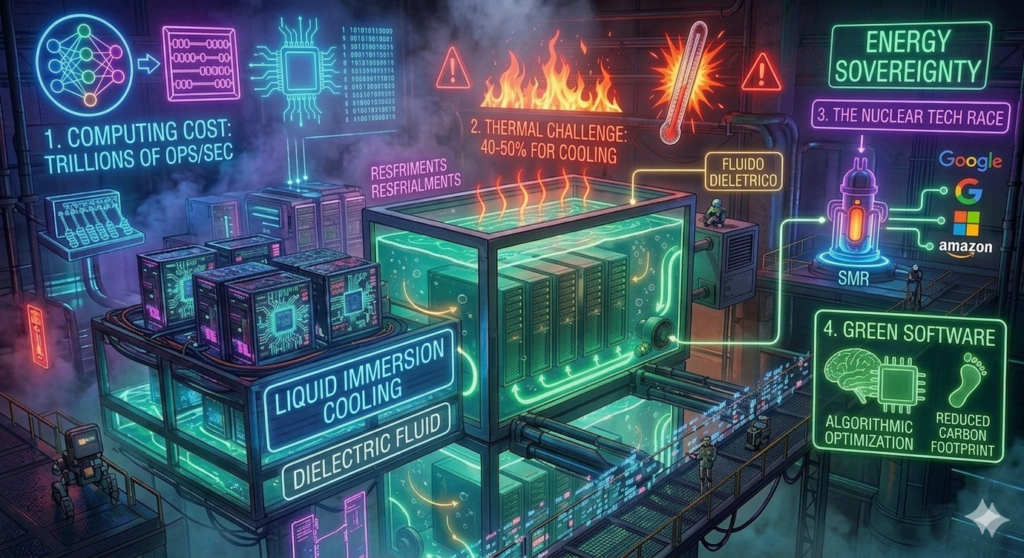
In 1845, the telegraph changed the world using only low-voltage electrical pulses. In 2026, Artificial Intelligence is redesigning civilization, but at a monumental energy cost. What happens inside large processing hubs (Data Centers) is a challenge that goes beyond computing: it is a battle against physics and heat.
But why, exactly, does AI require so much electricity? The answer lies in a combination of massive calculations, cooling infrastructure, and the new pursuit of energy sovereignty.
1. The Cost of “Reasoning”: Trillions of Calculations per Second
The basic unit of AI processing is the GPU (Graphics Processing Unit) or the TPU (Tensor Processing Unit). For models like Gemini or GPT to function, these boards perform trillions of mathematical operations per second (specifically matrix multiplications).
- Electron Flow: For every calculation, billions of transistors inside the chips need to “flip” on and off. For instance, for a model like Gemini to process a single prompt, it activates trillions of parameters. This requires billions of transistors within the chips to switch simultaneously. This constant movement of electrons through physical resistance generates heat and consumes electricity continuously.
- Scalability: A single modern AI server can consume as much power as several households combined. When we multiply this by facilities housing 50,000 or 100,000 servers, the electrical load becomes comparable to that of mid-sized cities.
2. The Heat Problem: Constant Cooling
Approximately 40% to 50% of the energy consumed by a large data center does not go toward the “intelligence” itself, but rather toward preventing the hardware from melting. Chips operating at extremely high densities generate extreme thermal heat.
- Entropy: Because chips operate at such high densities, they generate a massive amount of thermal heat.
- Cooling Systems: To maintain stable temperatures, centers require powerful chillers, cooling towers, and, increasingly, liquid cooling systems (where fluid passes directly over the processor). Pumping this fluid and keeping giant fans operating 24/7 requires a monumental electrical load.
- The Evolution of Cooling: Traditional air conditioning is no longer enough. In 2026, we are seeing a transition to Immersion Cooling, where servers are submerged in tanks of dielectric oil (which does not conduct electricity). This fluid removes heat much more efficiently than air, but maintaining this circulation and heat exchange system requires heavy energy infrastructure.
3. Data Movement and Memory
AI does not just calculate; it needs to move data between memory (HBM – High Bandwidth Memory) and the processor at incredible speeds.
- Bandwidth: Moving data from one point to another within the server consumes energy. In models with trillions of parameters, internal data traffic is so intense that the “wiring” and communication between thousands of processing nodes generate their own energy demand, known as network overhead.
4. Fun Fact: The Concept of PUE
Efficiency is measured by a metric called PUE (Power Usage Effectiveness). A PUE of 1.1 means that for every 100 MW used for processing, 10 MW are spent on cooling. Keeping this number low is the number one priority for modern engineering.
- A PUE of 1.0 would be perfection (all energy goes to processing).
- Most AI centers aim for something around 1.1 to 1.2. This means that for every 100 MW used to “think,” the center needs another 10 to 20 MW just to keep the lights on and the system cool. Because of this, companies like Google and Microsoft are investing in their own Small Modular Reactors (SMRs) to ensure stable, clean energy.
5. Energy Sovereignty and the Tech Nuclear Race
Demand is so high that energy consumption has become a matter of national security and sovereignty. Big Tech can no longer rely solely on the public electrical grid, which is often unstable or based on fossil fuels.
- Small Modular Reactors (SMRs): Google, Microsoft, and Amazon are investing in their own SMRs. These are next-generation nuclear plants—compact and safe—built alongside Data Centers to guarantee clean, uninterrupted power 24/7.
- Strategic Location: In 2026, processing centers are no longer built just where fiber optics are available, but where there is an abundance of renewable energy or natural cold to reduce cooling costs.
6. Green Software: Algorithmic Efficiency
Hardware isn’t the only solution. Software optimization is the other side of the coin.
- Quantization and Pruning: Developers use techniques to reduce the number of bits required to represent information in AI. This decreases the mathematical effort required by the chip, drastically reducing heat generation and power consumption without losing accuracy.
Conclusion: AI Success Depends on the Kilowatt-Hour
The future of Artificial Intelligence in 2026 will not be defined only by who has the best code, but by who can power that code sustainably and efficiently. AI has democratized execution but has placed a premium on infrastructure. Technological success is now, inseparably, an energy success.
What is your opinion? Contribute to the blog by sharing your insights!