
Series: The History of DNA Technology — Part 2
If you haven’t read part 1 yet, click here to do it.
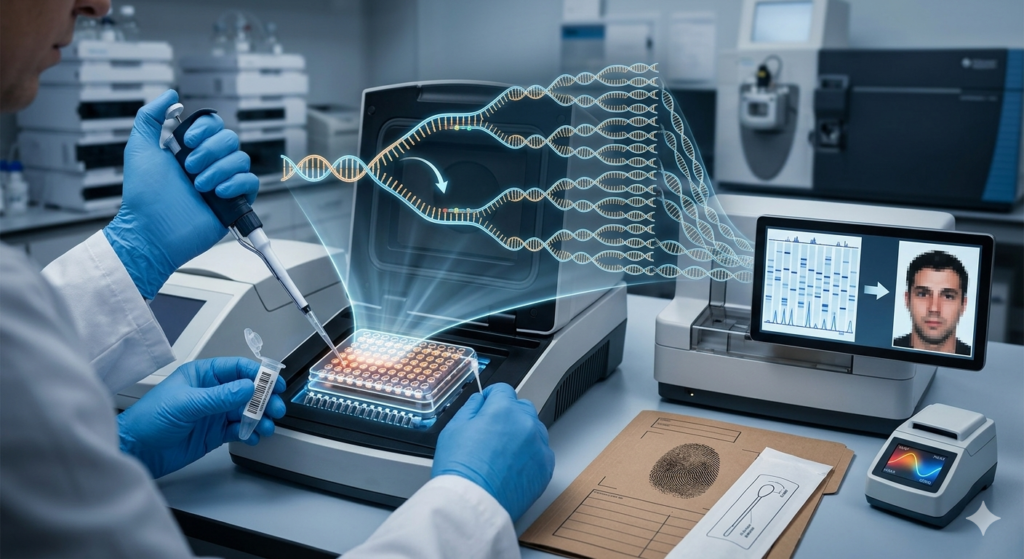
The Idea Born on a California Highway
If Alec Jeffreys had his “eureka” moment in a laboratory in Leicester, Kary Mullis’s moment happened in a much more cinematic way.
In 1983, biochemist Kary Mullis was driving from the San Francisco Bay Area to his cabin in Mendocino when, as suddenly as a lightning bolt across the California sky, he invented a way to locate a specific part of DNA and synthesize a massive amount of copies. He had to pull the car over to jot down the idea. At that moment, PCR—Polymerase Chain Reaction—was born.
Developed in 1983 by Mullis while he was an employee at Cetus Corporation, PCR is an easy, inexpensive, and reliable way to repeatedly replicate a specific segment of DNA—a concept applicable to various fields of modern biology and related sciences.
🔬 The Problem PCR Came to Solve
In Part 1 of this series, we saw that Jeffreys’ RFLP technique required micrograms of well-preserved DNA, took one to two weeks to produce results, and relied on radioactive materials that were difficult to import.
PCR arrived to turn that scenario upside down. Its principle is simple and brilliant: if the DNA in a sample is scarce, copy it billions of times until there is enough material to analyze.
PCR enables the synthesis of DNA fragments using DNA polymerase, the same enzyme involved in the replication of genetic material within cells. This enzyme synthesizes a complementary DNA sequence provided that a small fragment—the primer—is already bound to one of the DNA strands at the chosen starting point. Primers define the sequence to be replicated, and the result is the amplification of a specific DNA sequence into billions of copies.
⚙️ How PCR Works – The Three Stages of the Cycle
The process is based on repeated temperature cycles, mimicking what DNA does naturally when it replicates inside our cells:
- Denaturation — Heating to 94–95°C: The DNA is heated to separate the double helix into two single strands—much like how DNA unwinds inside our cells during natural replication.
- Annealing (Hybridization) — Cooling to 55°C: The sample cools, allowing the primers—small, artificially synthesized DNA fragments—to attach near the selected part of the DNA, preventing the two original strands from rejoining.
- Extension (Polymerization) — Heating to 72°C: The temperature rises again to 72°C, the ideal temperature for the polymerase to use the primers as a starting point to create new DNA strands, reforming the double helix.
This three-stage cycle repeats between 20 and 40 times in an automatic sequence. With each cycle, the number of copies doubles: 1 becomes 2, 2 becomes 4, 4 becomes 8… until billions of copies of the desired segment are achieved in just a few hours.
🦠 The Unlikely Hero: A Hot Spring Bacterium
The major initial technical obstacle for PCR was that the DNA polymerase used in early experiments—extracted from common E. coli bacteria—was destroyed during each 95°C heating cycle. A technician had to open the equipment and manually add new enzymes at every stage—a laborious and expensive process.
The solution came from an unusual place: the bottom of volcanic hydrothermal vents.
Taq polymerase is a thermostable enzyme named after the thermophilic bacterium Thermus aquaticus, from which it was originally isolated. It is frequently used in the polymerase chain reaction to enormously amplify short DNA segments. T. aquaticus lives in hot springs and hydrothermal vents; Taq polymerase was identified as an enzyme capable of withstanding the protein denaturation conditions—high temperatures—required during PCR.
The discovery of Taq polymerase was the decisive step for PCR’s expansion: the enzyme did not need to be added at every cycle because it can withstand temperatures above 100°C. With this, the process could be completely automated.
🖥️ The Equipment That Changed Everything: The Thermal Cycler
With Taq polymerase available, all that was missing was equipment that could control temperature cycles with precision and speed. It arrived in 1987.
With the patenting of PCR by Perkin-Elmer in 1987, automation for controlling temperature increases and decreases was developed—this is when the thermal cycler emerged.
The thermal cycler features a thermal block with slots for reaction tubes. The device increases and decreases the temperature according to the user’s programming. In practice, a scientist would place tubes containing DNA, primers, Taq polymerase, and reagents into the machine, program the cycles, and… wait. In hours, work that previously took weeks was done.
Other 1990s-era PCR equipment included:
- Precision micropipettes: For measuring microliter volumes of reaction reagents.
- Microcentrifuge tubes (0.2 ml Eppendorfs): Ultra-thin-walled tubes essential for efficient heat transfer in the thermal cycler block.
- Benchtop centrifuge: To homogenize and settle reaction components before cycling.
- Agarose gel electrophoresis chamber: To visualize the amplified fragments after PCR, confirming correct amplification.
- UV transilluminator with camera: To record the band pattern on the ethidium bromide-stained gel.
- -20°C Freezers: To store enzymes, primers, and dNTPs (the “building blocks” of DNA: adenine, thymine, cytosine, and guanine in triphosphate form).
🚔 PCR Arrives in Forensic Genetics
The impact of PCR on forensic science was immediate and devastating—in the best way possible. For the first time, it was possible to work with microscopic samples collected from crime scenes:
The sensitivity of PCR makes it possible to use very small samples—minimal traces of blood and tissue that might contain the remains of only a single cell—and still obtain a “DNA fingerprint” of the individual, allowing comparisons with victims and suspects in criminal cases.
A single hair follicle, a dried saliva stain on a cigarette butt, or skin cells under a victim’s fingernails—all of this became sufficient material for a complete examination. The turnaround time between sample collection and the final report, which was at least eight weeks during the O.J. Simpson trial in the mid-1990s, began to drop drastically with the arrival of PCR-based automation.
🏆 The Nobel Prize and Recognition
Kary Mullis described the process in 1983, but it wasn’t until ten years later, in 1993, that he received the Nobel Prize in Chemistry for his work. In 1989, the Hoffmann-La Roche & Perkin-Elmer Corporation patented the technique.
This delay in recognition reflects the time the scientific community took to grasp the full scope of the discovery—which today is used in medical diagnostics, archaeological research, victim identification, and even paternity tests available at any local lab.
📊 RFLP vs. PCR – The Technological Shift
| Feature | RFLP (1980s) | PCR (1990s) |
| DNA Amount Needed | Micrograms | Nanograms (or less) |
| Result Time | 1 to 2 weeks | Hours |
| Degraded Samples | Did not work | Effective |
| Radioactivity | Required | Not required |
| Automation | Manual | Fully automated |
| Cost | Extremely High | Increasingly affordable |
📅 Timeline — The Era of PCR
| Year | Milestone |
| 1983 | Kary Mullis conceives PCR during a road trip |
| 1986 | Taq polymerase discovered as the ideal thermostable enzyme |
| 1987 | Perkin-Elmer launches the first automated thermal cycler |
| 1989 | PCR patented by Hoffmann-La Roche & Perkin-Elmer |
| 1993 | Mullis receives the Nobel Prize in Chemistry |
| 1994 | PCR enters early forensic databases (O.J. Simpson case era) |
In the next post in this series, we will cover the arrival of STR (Short Tandem Repeats) markers and the first criminal DNA databases—the technology that made large-scale genetic matching possible and remains the foundation of modern forensic exams today.
Feel free to comment below!