
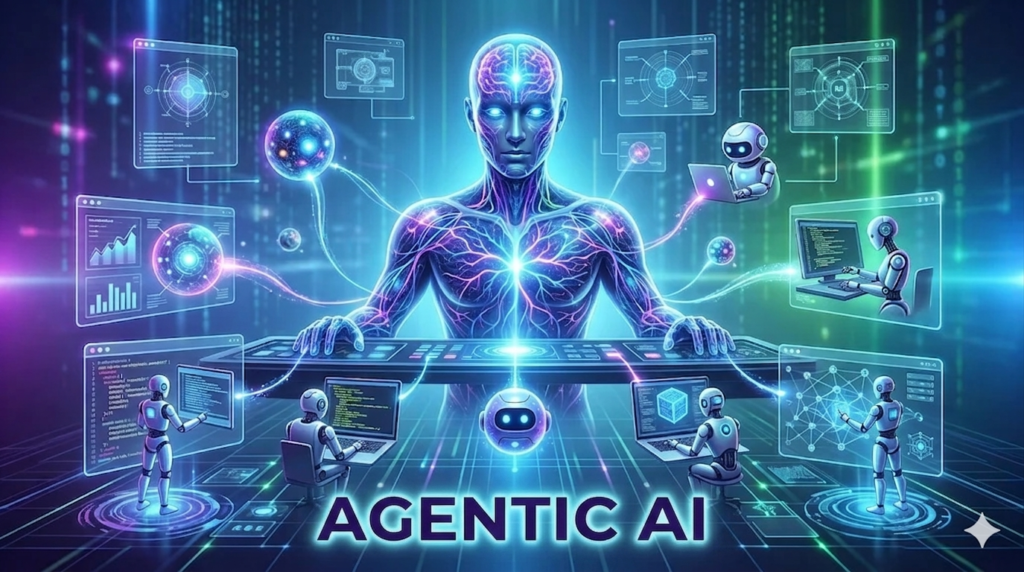
Imagine walking into your office, and before you even say “good morning,” your digital assistant has already reviewed your schedule, dispatched bureaucratic emails, and prepared a report on a sudden drop in production line efficiency. It didn’t wait for your command; it acted because it understood the ultimate objective.
We are no longer talking about tools that simply answer questions. We are in the era of Advanced Artificial Intelligence, where AI has evolved from a talking encyclopedia into an active agent in both physical and digital realities.
Advanced AI represents the natural evolution of traditional systems. Unlike legacy models that only react to prompts, this new generation—known as Agentic AI—is capable of making decisions, planning actions, and executing them autonomously. This breakthrough is redefining business, automation, software development, and productivity, becoming one of the most sought-after topics in the world of technological innovation.
What Really is Advanced AI? (Beyond the Hype)
Advanced AI isn’t just a “larger ChatGPT.” It is the convergence of architectures that allow the machine to break out of the question-and-answer cycle. In 2026, this ecosystem is sustained by four technical pillars:
- Multimodal and Sensory Reasoning: AI now “sees” the world through cameras, “hears” through acoustic sensors, and interprets code or text simultaneously.
- Edge Reinforcement Learning (Edge RL): Unlike traditional RLHF, modern AI learns from its environment in real-time, adjusting its behavior without needing a new training round on massive servers.
- Evolutionary Contextual Memory: Thanks to dynamic vector databases, the AI maintains a “biography” of your interactions, allowing it to understand nuances and preferences you demonstrated months ago.
- Agentic Architectures: The heart of the change—the “Think-Act-Observe” model. The AI defines a goal, executes a task, observes errors, and corrects its own course.
Practical Applications of Agentic AI in Today’s World
🏋️ The Invisible Coach: Agentic AI in Health and Fitness
AI autonomy has reached our bodies. Intelligent agents now act as proactive personal trainers:
- Dynamic Load Adjustment: By monitoring wearable data, the AI detects if your heart rate or muscle fatigue deviates from the plan and modifies your workout in real-time.
- Injury Prevention: Using local computer vision, the AI analyzes your form during squats or runs, providing immediate biofeedback to correct risky movements.
🤖 Self-Managing Factories
Forget robots programmed to repeat the same movement a thousand times. In modern industry, we have Organic Production Lines:
- Adaptive Robots: If a part arrives slightly off-angle, the AI processes the image and adjusts the robotic arm in milliseconds. If a gear shows wear, the agent orders the replacement part itself and reschedules the workflow to prevent downtime.
- Industrial Hives: Robots no longer work in isolation; they exchange data to optimize energy consumption and belt speed, acting as a single intelligent organism.
🚚 The Invisible Flow: Autonomous Vehicles (AGVs and AMRs)
Within industrial complexes and logistics hubs, movement is dictated by “brains” rather than drivers:
- AMRs (Autonomous Mobile Robots): Using LiDAR and advanced AI, AMRs bypass obstacles and create dynamic routes in massive warehouses.
- Last-Mile Logistics: Autonomous trucks and drones coordinated by a central AI ensure inventory arrives even before the consumer finishes the purchase by predicting regional demand with surgical precision.
🚗 Autonomous Passenger Vehicles Self-driving cars represent the pinnacle of Multimodal AI, turning driving into a convenience-led experience:
- 360-Degree Perception: AI processes data from high-res cameras, LiDAR, and radar simultaneously, “seeing” through fog and total darkness.
- V2X (Vehicle-to-Everything): In 2026, cars “talk” to each other and urban infrastructure. A car tells the one behind it that it’s braking, or receives a signal from a traffic light about a phase change, eliminating human error.
🛡️ Proactive Cybersecurity (Threat Hunting)
- Autonomous Defense: Instead of just blocking known viruses, AI agents act as “sentinels.” They detect suspicious network behavior, isolate the affected system, and investigate the attack’s origin, closing digital “doors” on their own.
🧪 Scientific and Academic Research
- Literature Review Agents: AI that doesn’t just summarize but actively searches global databases (like PubMed or IEEE), organizing citations by relevance and identifying knowledge gaps. For those looking to unlock their academic writing—whether for a thesis or dissertation—resources like AI-Powered Scientific Writing Mentorship teach how to use these tools ethically to maintain originality while overcoming writer’s block.
🏗️ Engineering, Business, and Predictive Maintenance
- Digital Twins: An AI agent monitors a virtual replica of a bridge or turbine. If sensors indicate abnormal vibration, the AI simulates 10,000 failure scenarios to predict when a part will break and schedules maintenance automatically.
The Ethical Challenge: Autonomy with Responsibility
With great power comes great dilemma. In 2026, the discussion centers on Explainable AI (XAI): the requirement for AI not only to make a decision but to explain “why” so humans can audit it. Additionally, protecting against prompt injection (attempts to trick AI into leaking data) has become the number one priority in modern cybersecurity.
Conclusion
We are leaving passive systems behind and entering a world where machines think, act, and learn continuously. The competitive advantage now belongs to those who understand the dance between man and machine.
We are moving from the era of “knowing how to use tools” to the era of “knowing how to manage digital talent.”
Do you feel comfortable delegating decisions—from your physical training to your work reports—to an AI agent? Share your thoughts in the comments!