
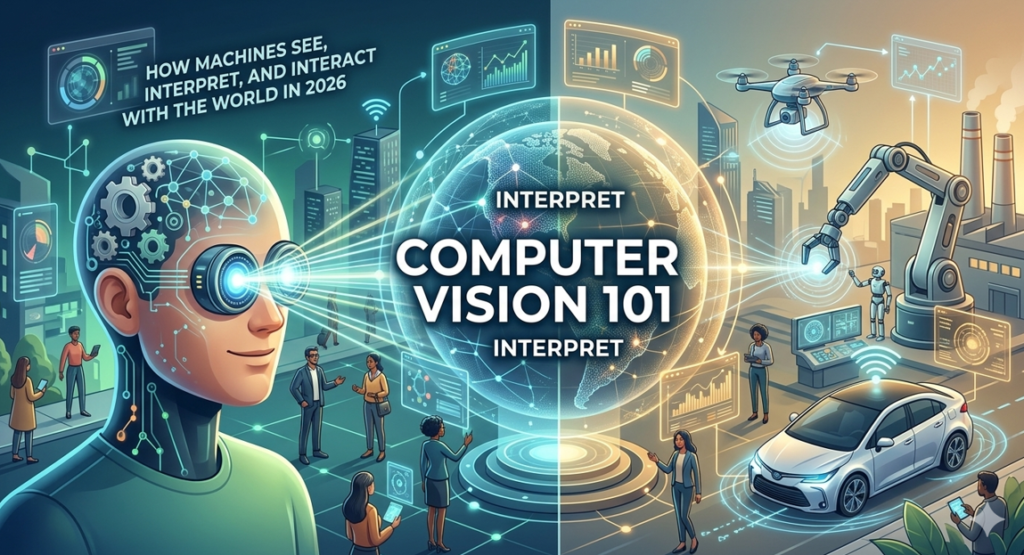
Computer Vision: What It Is, How It Works, and Why It’s Everywhere
In simple terms, Computer Vision (CV) is the subfield of Artificial Intelligence that trains computers to “see and interpret” the visual world—just as we humans have done naturally since our first months of life. While a standard camera merely records pixels (color points on a numerical grid), a Computer Vision system utilizes Deep Learning algorithms to understand what those pixels represent, the context in which they appear, and, frequently, what actions to take based on that information.
How Does It Work in Practice?
The process generally follows four fundamental stages:
- Image Acquisition Capture is performed via standard RGB cameras, infrared sensors, Time-of-Flight (ToF) depth cameras, LiDAR, satellites, or even medical imaging like CT scans and MRIs. The source can be a static photo, real-time video, or a continuous stream of visual data.
- Preprocessing Before analysis begins, the image undergoes “cleaning” and standardization: adjusting brightness and contrast, noise removal, resizing, and pixel value normalization. This stage is invisible to the user but critical for the accuracy of the final result.
- Processing and Feature Extraction The computer transforms the image into numerical data—to a machine, a photo is a massive matrix of numbers. Convolutional Neural Networks (CNNs) scan this matrix looking for patterns: edges, shapes, textures, colors, and structures. Deeper layers of the network identify increasingly complex patterns—moving from a simple edge to the full contour of a face.
- Interpretation and Decision Making The AI looks for patterns learned during training. If it detects a specific set of shapes and textures consistent with millions of cat images it previously analyzed, it concludes: “This is a cat.” It can then go further, estimating the animal’s breed, approximate age, or emotional state.
Real-World Examples
Computer Vision is already more integrated into your daily routine than you might realize:
- 🏋️ Health and Fitness: It allows your phone to “see” the angle of your knee during a squat and alert you if your form is incorrect—preventing injuries without needing a physical personal trainer present.
- 🔓 Facial Recognition: Enables your smartphone to unlock the screen by identifying your unique facial features in fractions of a second, even in low light, using infrared 3D mapping.
- 🚗 Autonomous Vehicles: Allows the vehicle to identify lane markings, pedestrians, traffic lights, signs, and obstacles in real-time—integrating data from cameras, LiDAR, and radar simultaneously to make decisions in milliseconds.
- 🏥 Medical Imaging and Diagnostics: Software analyzes X-rays, MRIs, and CT scans to detect tumors, fractures, and anomalies with precision that often exceeds the human eye, especially during periods of fatigue. Systems like Google DeepMind have already demonstrated an ability to outperform experienced radiologists in early breast cancer detection.
- 🛒 Smart Retail: Amazon Go stores use Computer Vision to track which products a customer removes from the shelf and automatically charges them upon exit—no cashiers, no lines, no friction.
- 🏭 Industrial Quality Control: High-speed AI cameras inspect thousands of products per minute on assembly lines—identifying manufacturing defects invisible to the human eye, such as micro-cracks in metal parts or imperfections in smartphone screens.
- 🌱 Precision Agriculture: Drones equipped with Computer Vision fly over crops to identify areas with pests, nutrient deficiencies, or water stress—allowing for surgical intervention in exact locations, saving water and resources.
Technical Curiosity: The Fusion with LLMs
The most significant recent leap was the integration of Computer Vision with Large Language Models (LLMs). This fusion created Multimodal Models, such as GPT-4o, Gemini, and Claude, which combine vision and language natively.
Now, the AI doesn’t just “see” a plate of food; it can describe it in rich detail: “This is a plate with approximately 400g of grilled chicken and steamed broccoli. I estimate about 35g of protein, 12g of carbohydrates, and 8g of fat—suitable for a post-workout meal.”
Image Recognition vs. Computer Vision
While these terms are often used interchangeably, for those writing about technology, understanding the distinction is fundamental. In short: Image Recognition is one piece of the larger puzzle that is Computer Vision.
1. Image Recognition — Identification
This is the AI’s ability to classify what is in an image. It answers the question: “What is this?”
- Focus: Categorization and labeling of objects or scenes.
- Practical Example: Google Photos automatically grouping all photos of your dog into one album without you having to label anything.
2. Computer Vision — Comprehension and Action
This is a much broader field that seeks to emulate the entire human visual system. It doesn’t just identify—it understands context, depth, movement, and spatial relationships. It answers: “What is happening here, and how should I react?”
- Focus: Full scene interpretation and data extraction for real-time decision-making.
- Practical Example: An autonomous car doesn’t just “recognize” a pedestrian; it calculates the person’s speed, distance in meters, probable trajectory, and decides in milliseconds whether to brake, swerve, or maintain speed.
| Feature | Image Recognition | Computer Vision |
|---|---|---|
| Objective | Name or classify an object | Understand the scene and act on it |
| Complexity | Low to Medium | High (involves physics and geometry) |
| Action | Static, usually point-in-time | Dynamic and continuous (real-time) |
| Input Data | Single image | Video streams, multiple sensors |
Why This Distinction Matters in 2026
In a modern smartphone:
- Image Recognition is what allows your gallery to automatically sort “beach,” “mountain,” and “birthday” photos into themed albums.
- Computer Vision is what allows the phone to use its ToF (Time of Flight) sensor to scan an object in 3D, create a depth map, and blur the background of a video in real-time—tracking every strand of hair without blurring the face—while estimating the exact distance to the subject for surgical autofocus.
In 2026, Computer Vision has evolved from merely “identifying objects” into a continuous layer of perception for the physical world—integrated into wearables, AR glasses, domestic robots, and medical systems that operate 24/7 without fatigue.
We are, quite literally, teaching machines to see. And they are learning faster than anyone predicted.