
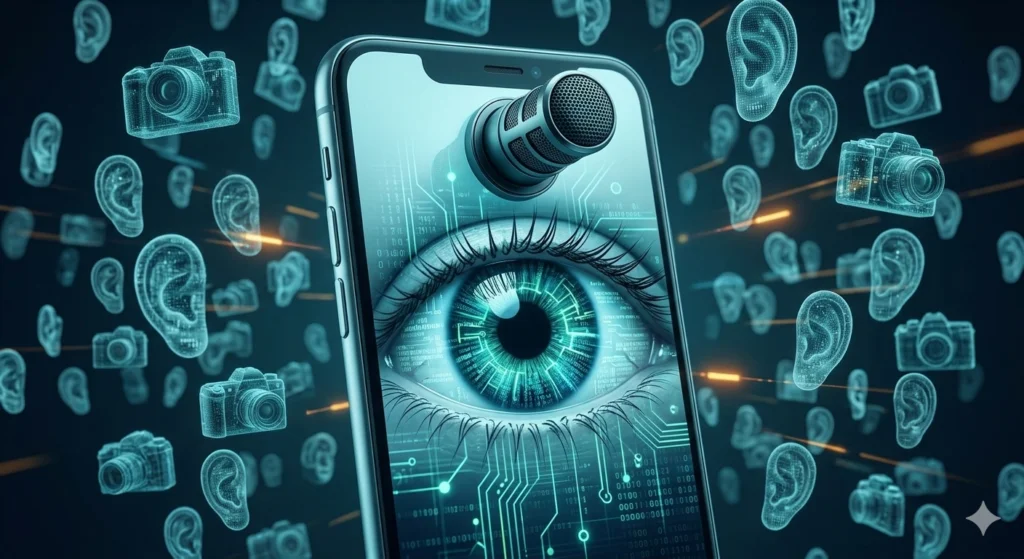
Coincidence or Espionage? The Day My Phone “Read” My Mind
You’ve lived this scene: you’re having coffee with a friend and, between sips, you talk about how amazing a vacation in Greece would be. You didn’t search for anything on Google, you didn’t open Instagram—you just spoke. Ten minutes later, you open your phone and—boom—there it is: a promotional package to Athens with a 30% discount.
A chill runs down your spine. You look at the device and think: “It’s listening to me!”
But what if I told you the truth is even more fascinating (and a bit more complex) than simple wiretapping? Get ready, because today we are going to dive into the “black box” of predictive marketing.
Myth or Reality: Is Your Phone Really Listening to You?
Many people believe that phones record conversations 24/7 to sell ads. The idea that a smartphone records audio around the clock and sends it to the cloud is largely a technical misconception due to the prohibitive cost of bandwidth and battery life. It would be a logistical nightmare and easily detectable through data and battery consumption.
To understand why your phone seems like a psychic, we need to look at the tools Big Tech uses to assemble the puzzle of your life:
1. Passive Listening and Sound “Token” Detection
Modern smartphones have ultra-low-power Digital Signal Processors (DSPs) dedicated exclusively to detecting wake words.
- The Detail: The system doesn’t understand sentences; it looks for sound wave patterns that match specific commands or brands.
- In 2026: With Agentic AI, these local models have become more robust. They can identify “acoustic events” (such as a baby crying, a dog barking, or glass breaking) to offer home automations or security ads—all processed via Edge AI without raw audio ever leaving the chip.
2. Device Fingerprinting and “Cross-Device Tracking”
This is the part that scares people most and yet few understand. Tech companies use metadata to link “points of coexistence.”
- Ultrasound Proximity: Some apps emit and capture sounds inaudible to the human ear (ultrasound) to identify if two devices are in the same room. If your friend searches for “trips to Japan” while sitting next to you, the system understands you share interests.
- Cross-Interests: If your friend (whose GPS is next to yours) searches for “trips to Bahia,” the AI understands you are together and begins displaying hotel ads to you as well.
- IP and Bluetooth Sync: If two phones share the same Wi-Fi for a long time, the AI assumes they belong to the same household or close friends, cross-referencing ads between them.
- Location (GPS/Wi-Fi/Bluetooth): It knows where you live, work, and which stores you visit. If you stand in front of a car dealership window for 10 minutes, the system infers you want to change vehicles.
3. “Digital Gait” Analysis (Sensors)
The phone doesn’t need a camera or microphone to know what you’re doing.
- Accelerometer and Barometer: Through the way the device shakes in your pocket, AI can identify if you are walking, running, driving, or taking public transit. The barometer can even tell which floor of a mall you are on. Accelerometers and gyroscopes can indicate your health status and even infer your mood by how you hold the device.
- Battery Level and Screen Brightness: Battery usage patterns and the times you adjust screen brightness help map your circadian rhythm, predicting when you are most prone to impulse buying (usually when you are tired at night).
4. Screen Awareness
This is the big breakthrough of 2026. AI integrated into the operating system can now “see” what you see.
- The Concept: The AI takes constant, invisible “snapshots” of your screen to understand the context of what you are reading or watching.
- The Risk: While this helps the AI give you quick answers about a video you just watched, it also catalogs every brand, name, and desire expressed in chat apps that theoretically have end-to-end encryption (like WhatsApp). The AI reads the interface, not the encrypted message.
5. How to Protect Yourself (or at least mitigate)
If you feel the “net is closing in,” here are some practical steps:
- Permission Management: Review which apps have access to your microphone and location set to “Always.” Many do not need this to function.
- Privacy Reports: On Android and iOS, use the “App Privacy Report” to see who accessed your sensors in the last 24 hours.
- Private DNS and VPNs: This helps mask the data traffic leaving the device toward telemetry servers.
6. Agentic AI: The New Frontier of 2026
With AI Agents integrated into the OS, “spying” has reached a new level. Now, the AI has permission to read your screen (Screen Awareness) to assist you with tasks.
- The Pro: It knows you received a bill and reminds you to pay it.
- The Risk: To be useful, it must observe everything you do in real time. Security here depends entirely on on-device processing. If this analysis goes to the cloud, privacy is virtually zero.
The Baader-Meinhof Phenomenon: The Frequency Illusion
Beyond the technical aspects, we must consider a psychological phenomenon: the Baader-Meinhof effect, or “frequency illusion.” This is a cognitive bias where, after learning or noticing something new, you begin to see it everywhere. It’s not a real increase in occurrence, but a shift in your selective attention.
In advertising: our brains ignore hundreds of irrelevant ads every day. But the moment you speak about something and see a related ad, your brain triggers a “pattern alert.” It’s like when you decide to buy a red car and suddenly start seeing red cars on every corner. They were always there; you just started noticing them now.
Other Pertinent Aspects: What Isn’t Said
- Telemetry and Diagnostics: Often, data collection is labeled as “diagnostic data.” Under the guise of improving system stability, manufacturers collect massive logs of how you interact with every button and how long you spend in each app section.
- The Role of NPUs in Privacy (The Good Side): In 2026, the trend of NPUs (Neural Processing Units) allows much of this “profiling” to be done for your exclusive benefit. For example, the AI learns you like black coffee and suggests nearby cafes, but this learning stays in a Local Silo (inside the chip) without ever being sent to company servers.
- Digital Markets Laws and Transparency: Thanks to stricter regulations, systems are now required to show visual indicators (green or orange dots) whenever the microphone or camera is accessed. However, sensor data collection (like the gyroscope) remains a legal gray area in most countries.
Conclusion
The smartphone is not a classic spy taking notes on your conversations; it is a statistical profiler. It knows your habits so well that when it shows you an ad for something you “just thought about,” it wasn’t magic or wiretapping—it was simply the AI connecting the dots of your digital behavior.
What about you? Waht do you think about it?
What was the most bizarre ‘coincidence’ you’ve ever experienced between a conversation and a mobile ad? Tell us all about it in the comments below!