
The Story of the Human Voice: From Acoustic Phenomenon to Light-Speed Pulse
The story of how the human voice ceased to be a mere acoustic phenomenon to become an electrical pulse traveling at the speed of light is one of the most fascinating chapters in engineering. It is a journey that begins with one man’s obsession with deafness and ends with the redefinition of human connection.
The Boston Dream: The Spark of Invention
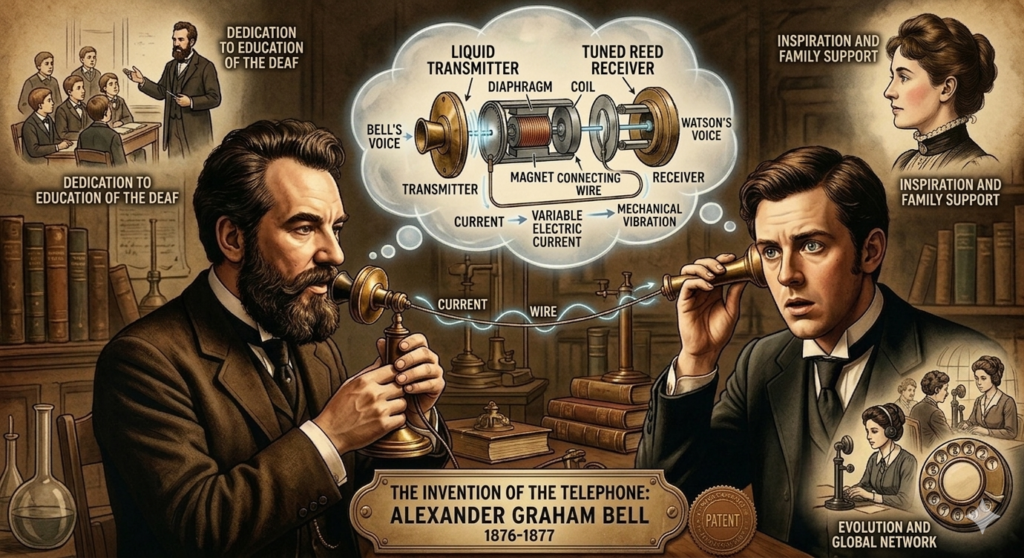
Imagine the city of Boston in 1875. In a dusty workshop, Alexander Graham Bell—an elocution professor who spent his days teaching the deaf to speak—was obsessed with an idea: if sound is a vibration and electricity can travel through wires, why couldn’t we “undulate” electricity so that it carried the vibration?
Bell was not alone; Elisha Gray and Antonio Meucci were treading similar paths. But Bell had a technical ally, the young Thomas Watson. They were working on the “harmonic telegraph,” attempting to send multiple telegraph messages simultaneously using different tones.
The “Eureka” moment happened on June 2, 1875. Watson was trying to loosen a metallic reed from a transmitter that had jammed. As he plucked the reed, he made it vibrate. In the other room, Bell heard a faint sound coming from his receiver. It wasn’t just a telegraphic “click”; it was the metallic timbre of a vibrating reed. Bell realized that the electric current in the wire was varying in intensity at the exact same frequency as the reed’s vibration.
Less than a year later, on March 10, 1876, came the famous phrase: “Mr. Watson, come here, I want you.” The human voice had, for the first time, ridden a bolt of electricity through a wall.
The Physics of the Voice: Transforming Air into Energy
To understand how Bell achieved this feat, we must dive into the physics of sound and electricity.
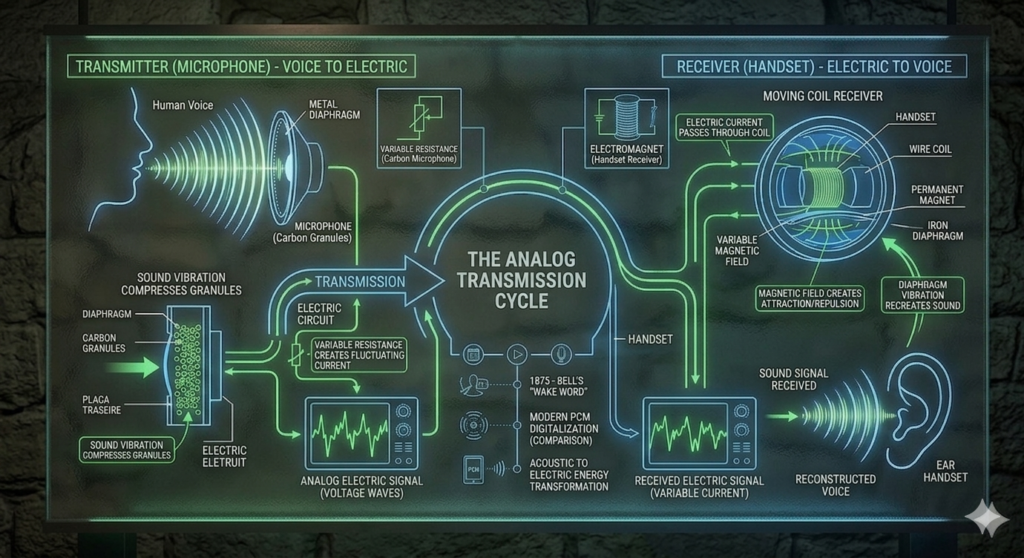
1. The Nature of Sound The human voice is a longitudinal mechanical wave. When you speak, your vocal cords vibrate, pushing air molecules and creating zones of compression (high pressure) and rarefaction (low pressure). These waves travel through the air until they hit a membrane.
2. The Transmitter (The Primitive Microphone) The great technical challenge was the transducer. Bell needed something that could convert the mechanical energy of sound into variable electrical energy. In Bell’s initial model (later improved by others like Thomas Edison), the concept of variable resistance was used:
- The Diaphragm: A thin sheet of metal (or parchment with a metallic piece) acted as an artificial eardrum.
- The Carbon Granule (Edison’s Invention): Inside the mouthpiece were small granules of carbon. When the sound wave hit the diaphragm, it pressed against these granules.
- The Physics of Compression: When the diaphragm pushed the granules (high sound pressure), they became more compact, decreasing electrical resistance. When the diaphragm receded (low pressure), the granules loosened, increasing resistance.
By applying a direct current (DC) to this circuit, the variation in resistance caused the electric current to fluctuate. Imagine a hose where you squeeze and release the nozzle to the rhythm of a song: the water coming out (the current) now has the “shape” of the music.
Traveling the Wire: The Analog Current
Once the voice was converted into electricity, it became an analog current. This means the electrical signal was a perfect analogy of the original sound wave. If the voice rose in pitch (high frequency), the electric current oscillated rapidly. If the voice got louder (high amplitude), the current variation was greater.
In this stage, electricity travels through copper wires. Copper is an excellent conductor, allowing electrons to flow with low resistance. However, the signal suffers from attenuation (energy loss) over distance, which would later require the use of loading coils and repeaters to make long-distance calls possible.
The Miracle of Reconstitution: The Receiver
On the other end of the line, the process had to be reversed. The receiver had to transform electrical pulses back into audible sound waves. This was solved through electromagnetism.
The Receiver Mechanism:
- The Electromagnet: Inside the earpiece was a coil of wire wrapped around an iron core.
- Magnetic Attraction: The variable current from the transmitter passed through this coil. According to Faraday-Lenz Law, a varying electric current creates a varying magnetic field.
- The Iron Diaphragm: Near the electromagnet was another metallic diaphragm. When the current was strong, the magnet pulled the diaphragm hard. When the current weakened, the pull decreased.
- Recreating the Air: This “push and pull” movement of the diaphragm occurred thousands of times per second, at the exact same rhythm as the speaker’s original voice. This movement pushed the surrounding air, recreating the waves of compression and rarefaction.
When these waves hit the listener’s ear, the brain processed the vibrations. The cycle was complete: Voice -> Mechanical Vibration -> Electric Current -> Magnetic Field -> Mechanical Vibration -> Voice.
The Evolution: From Current to Bit (The Digital Leap)
While Bell invented analog transmission, the modern world operates differently. In the 20th century, it was realized that analog signals were fragile. Any electrical noise on the wire was heard as static.
Thus, PCM (Pulse Code Modulation) emerged. Instead of sending the entire electrical “wave,” the system takes “snapshots” (samples) of the wave thousands of times per second (usually 8,000 times per second for voice). Each voltage level is transformed into a binary number (0s and 1s).
Today, when you speak on a cell phone, your voice undergoes this same physical process in the microphone, but it is instantly digitized into pulses of light in fiber optics or radio waves, only to be reconstructed on the other side.
Conclusion: The Legacy of Electric Sound
The invention of the telephone wasn’t just about wires and electromagnets. It was about translating one force of nature (sound) into another (electricity). Bell, motivated by a desire to help the deaf “hear” vibrations visually, ended up giving the world a voice that could cross oceans.
That Boston workshop gave rise to a global nervous system. Today, every time we answer a call, we are using the same physical principles of variable resistance and electromagnetism that Watson and Bell discovered—proving that, at its heart, technology is just the human voice trying to go a little bit further.