
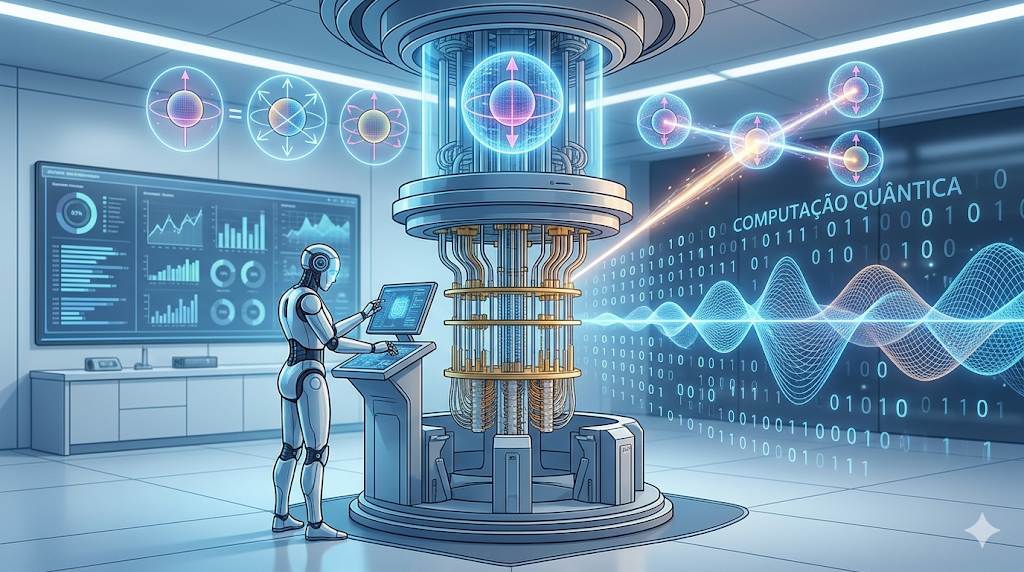
Quantum computing is a new paradigm in the field of computing that utilizes principles of quantum mechanics to process information in innovative ways. Unlike classical computing, which is based on bits representing states of 0 or 1, quantum computing uses qubits. A qubit can exist simultaneously in a state of 0 and 1 due to a phenomenon known as superposition. This ability to be in multiple states at once allows quantum computers to perform complex calculations with unprecedented speed.
Another fundamental concept is quantum entanglement, which describes a situation where two or more qubits become interconnected in such a way that the state of one qubit is directly related to the state of the other, regardless of the distance between them. This property can be used to create ultra-secure communication systems and significantly increase the efficiency of computational algorithms.
Quantum computers have the potential to solve problems that would be intractable for classical computing, such as the factorization of large numbers and the simulation of quantum materials. Although we are still in the early stages of developing this technology, research in quantum computing is advancing rapidly, and practical applications are beginning to emerge in various industries, including cryptography, materials science, and artificial intelligence.
Concepts and Principles of Quantum Computing
Quantum computing refers to a new information processing paradigm that distinguishes itself from classical computing. While classical computers use bits as the fundamental unit of information, corresponding to a state of 0 or 1, quantum computing operates with qubits, which have the capacity to represent both states simultaneously due to superposition. This fundamental characteristic of qubits is one of the primary drivers of quantum computing’s revolutionary potential.
In addition to superposition, another crucial principle is quantum entanglement. When qubits become entangled, the state of one qubit is directly influenced by the state of another, regardless of the distance separating them. This property allows information to be shared and processed in a far more efficient manner than would be possible with classical bits.
In terms of processing, this translates into an exponential capacity to solve complex problems. Problems that might take centuries to solve under classical computing have the possibility of being addressed in significantly less time by quantum computers. For example, Shor’s algorithm, which can factor large integers efficiently, exemplifies how quantum computing can impact areas such as cryptography and cybersecurity.
Analogies help clarify these concepts. Imagine a maze: a classical computer tries one exit at a time, whereas a quantum computer can explore multiple routes simultaneously. This parallel processing capability illustrates the efficiency gained through quantum principles. As we advance in our understanding and development of quantum computing, it is crucial to explore how these concepts translate into practical applications and how they may shape the future of technology.
Origin and Evolution of Quantum Computing
Quantum computing has its roots in the field of quantum mechanics, which began to be formalized in the early 20th century. The first discussions regarding the possibility of using quantum principles for complex calculations began to gain momentum in the 1980s. Richard Feynman, one of the pioneers of quantum physics, proposed in 1981 that a quantum computer could simulate quantum phenomena more efficiently than the classical computers of that era. This idea laid the foundation for the development of quantum computation theory.
In 1985, David Deutsch, another fundamental physicist in the field, formalized the underlying concepts of the quantum computer, describing a machine capable of solving complex computational problems that were intractable for traditional methods. The concept of the qubit, the basic unit of information in quantum computing, began to gain prominence, offering a new paradigm compared to the classical bit. The theoretical exploration of these concepts paved the way for the practical innovations that followed.
From the 1990s onward, research in quantum computing began to expand significantly with the introduction of quantum algorithms, such as Shor’s algorithm, which demonstrated the ability to factor large numbers exponentially faster than the best known classical algorithms. These innovations emphasized the disruptive potential of quantum computing, sparking interest from academia and industry worldwide.
Since then, quantum computing has evolved rapidly, with the creation of prototypes and quantum systems that, while still in early stages, demonstrate the real possibilities of information processing using quantum principles. The trajectory of quantum computing, from its theoretical origins to its first practical implementations, is crucial for understanding its current applications and future expectations.
Current Applications and Future Expectations
Quantum computing, even in its initial stage, already presents a range of applications that demonstrate its disruptive potential across various industries. One of the most promising areas is cryptography, particularly in protecting sensitive information. Quantum algorithms, such as Shor’s, can break traditional encryption systems that currently guarantee data security. This has resulted in significant efforts to create new methods based on quantum principles that can offer robust security.
In addition to cryptography, materials simulation is a current application that could have major implications for the chemical industry and materials science. The ability to simulate interactions between atoms and molecules at a quantum scale can accelerate the development of new materials with desired properties—such as superconductors and new pharmaceuticals—that would be difficult to discover using classical methods. Several companies are investing in this area, seeking to explore the energy surfaces of new chemical compounds.
Regarding process optimization, quantum computing can transform sectors such as logistics and finance, where efficient solutions are crucial. Quantum algorithms can solve complex optimization problems much faster than classical approaches, which can lead to significant savings in operational costs and processing time.
As for future expectations, many projects are under development, offering a glimpse of what quantum computing will be able to achieve. However, it is vital to recognize the challenges that still need to be overcome, such as qubit fragility and the scalability of the technologies. Large-scale adoption will depend not only on technical breakthroughs but also on a deeper understanding of its applications and the legislation that may emerge along the way.