
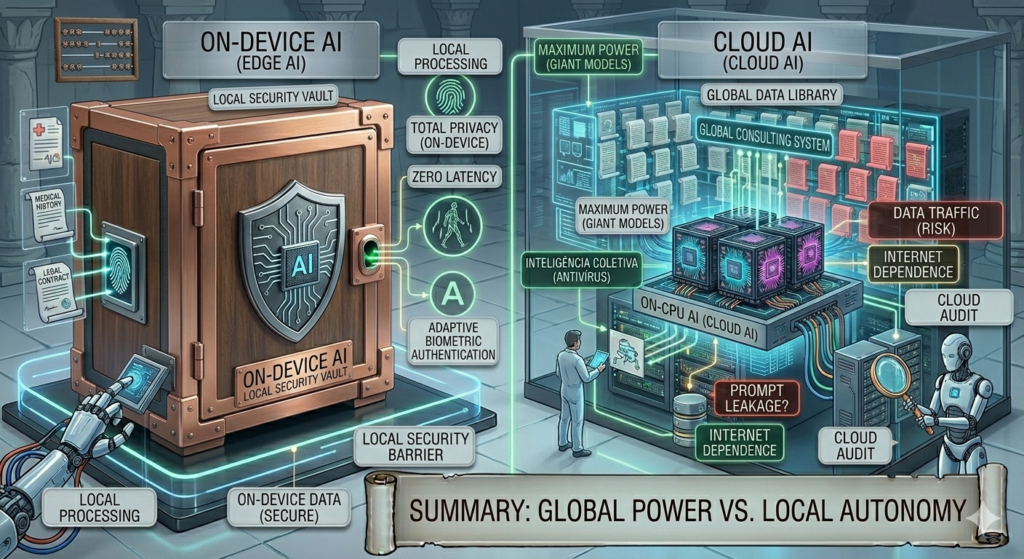
1. Cloud AI: The Distant Supercomputer
Cloud AI relies on massive data centers. When you ask a complex question, your device sends the data to a powerful server, which processes the response and sends it back.
- Concept: Centralized processing on high-performance servers (GPUs/TPUs).
- Advantage: “Infinite” capacity. It can run the world’s heaviest and most complex models that no smartphone could handle alone.
- Disadvantage: Dependence on internet connectivity and latency (response delay). Furthermore, your data leaves your direct control.
- Practical Example: Using Gemini Ultra or GPT-4 to analyze a 10-year legal database. The volume of calculations is so immense that processing must be done in a cloud server cluster.
2. On-Device AI: The Local Brain
With the arrival of NPUs (Neural Processing Units) integrated into modern smartphone and laptop chips, AI can now “live” inside the hardware.
- Concept: Local processing, utilizing the device’s own silicon.
- Advantage: Total privacy (data never leaves the device) and instantaneous response (zero latency), working even in airplane mode.
- Disadvantage: Limited by the device’s battery and thermal power. It cannot run models with trillions of parameters (yet).
- Hypothetical Example: A health assistant that monitors your heart rate and private conversations to detect signs of anxiety. Since this is highly sensitive data, processing occurs only on your smartwatch/phone, ensuring no one (not even the manufacturer) has access.
3. Relevant Insights: What No One Tells You
Beyond the obvious, three points are transforming the market this year:
- A. Hybrid AI (The Best of Both Worlds): In 2026, most systems use Hybrid AI. The device attempts to solve the task locally (faster and cheaper). If the task is too complex, it automatically “asks for help” from the cloud.
- B. Token Economy and Operational Cost: For companies, On-Device AI is a financial blessing. Running Cloud AI costs billions in electricity and hardware. By “pushing” the processing to the user’s phone, the company saves on infrastructure—it’s the decentralization of cost.
- C. Sustainability and Carbon Footprint: Cloud AI requires massive cooling and constant energy. On-Device AI is much more energy-efficient for routine tasks, eliminating the energy spent transmitting data via undersea cables and satellites.
Pocket Comparison Table
| Feature | Cloud AI | On-Device AI (Local) |
| Processing Power | Maximum (Giant Models) | Moderate (Optimized Models) |
| Privacy | Lower (Data in transit) | Maximum (Data stays on chip) |
| Connectivity | Requires Internet | Works Offline |
| Latency | Network dependent | Instantaneous |
| Battery | Saves phone (Cloud does the work) | Consumes more phone battery |
4. The Privacy Factor: Where Does Your Data “Sleep”?
In 2026, privacy is no longer just a “Terms of Use” checkbox; it is a physical barrier.
- Anonymization vs. Data Sovereignty: In Cloud AI, even with encryption, your data resides on third-party servers. There is a risk of “prompt leakage,” where confidential information sent to the AI could theoretically be used to train future versions of the model.
- Local Data Silos: In On-Device AI, the core concept is Sovereign Data. If you ask the AI to summarize a medical history or a confidential legal contract, that content is processed in the volatile RAM of your chip and discarded after execution. The data never “touches” the internet.
5. Security: Active Defense and Silent Attacks
Security has evolved from “firewalls” to “intelligent watchmen” that act differently in each environment:
- In the Cloud (Security at Scale): The advantage is collective intelligence. If a new virus is detected in a server in Asia, the Cloud AI learns instantly and protects all users globally within seconds. Risk: The “Cloud Meltdown”—if a provider suffers a large-scale Prompt Injection attack, millions of accounts could be compromised simultaneously.
- On the Device (Edge Security): Local AI turns the smartphone into a 24/7 personal security expert. It monitors system behavior; if an app attempts to access the microphone or camera atypically, the AI blocks the process before it even attempts to connect to the network. Adaptive Biometric Authentication also analyzes your typing rhythm and how you hold the device to detect unauthorized users.
6. The “Black Box” Challenge and Auditing
A critical differentiator is transparency:
- Cloud Auditing: You must blindly trust the company’s transparency reports.
- Local Auditing: Developers and consumer protection agencies can audit the code running on the device much more easily to ensure no “backdoors” are sending hidden data abroad.
Conclusion: The Necessary Balance – A Hybrid and Private Future
Ultimately, the choice between Cloud AI and On-Device AI is not about exclusion, but a matter of context and priority. While the cloud provides us with the breadth of global knowledge and massive computational power, on-device processing gives us back the digital age’s most precious asset: data sovereignty. As we move forward, the definitive trend is the hybrid model, where intelligence flows seamlessly between your pocket and the vastness of the network, ensuring your device is both a powerful assistant and an unbreakable vault.
In short, Cloud AI is your Global Consultant: it knows everything on the internet but “gossips” with the server. On-Device AI is your Private Vault: it may not know everything happening in the world, but it would die with your secrets – at least, theorically.
And you? Would you rather give up some convenience in exchange for maximum privacy, or do you value the unlimited capacity the cloud offers? Leave your thoughts in the comments on the future of our digital autonomy.