
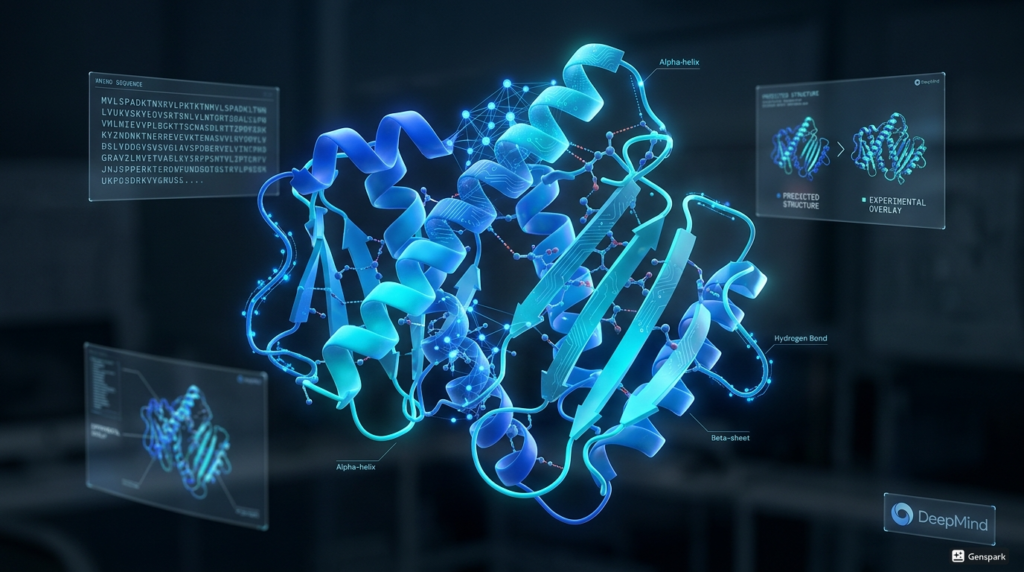
AlphaFold: The “Google Maps” of Biology That Unlocked the Mystery of Proteins
If advanced Artificial Intelligence is redefining factories and cars, there is one field where it has accomplished what many scientists once considered impossible: molecular biology. In just a few days, AI solved a problem that had plagued science for 50 years, opening the doors to a new era of medicine. We are talking about AlphaFold.
AlphaFold is a disruptive AI solution developed by DeepMind (a Google subsidiary) to solve the “protein folding problem,” a challenge that had intrigued molecular biologists for five decades. The system utilizes advanced neural network architectures known as Transformers to interpret the chemical sequence of amino acids and predict, with laboratory-grade precision, the final three-dimensional structure of a protein.
What is the “Folding Problem”?
Proteins are the “machines” of our bodies. They fight diseases, digest food, and transmit nerve signals. However, for a protein to function, it cannot remain a simple sequence of amino acids; it must fold into a specific and extremely complex 3D shape.
For decades, discovering the exact shape of a single protein required years of arduous lab work and millions of dollars. Without knowing the shape, we didn’t know how the protein functioned—or how to design a drug to block it.
The AlphaFold Leap
Developed by DeepMind, AlphaFold utilized advanced AI neural networks to predict the structure of nearly every protein known to science in record time.
- Unprecedented Speed: What used to take years of physical experimentation is now solved by AI in minutes or hours.
- Gold-Standard Accuracy: The AI achieved precision comparable to the most expensive experimental methods, such as X-ray crystallography.
- Global Database: Today, scientists worldwide have free access to a catalog of over 200 million protein structures—a true map of life.
To understand how AlphaFold works, one must visualize the AI not just as software, but as a “master architect” that learned the universal rules of life’s construction. The system solved a 50-year challenge by predicting how a linear sequence of amino acids folds into a complex three-dimensional structure.
⚙️ The Inner Workings: AlphaFold’s Architecture
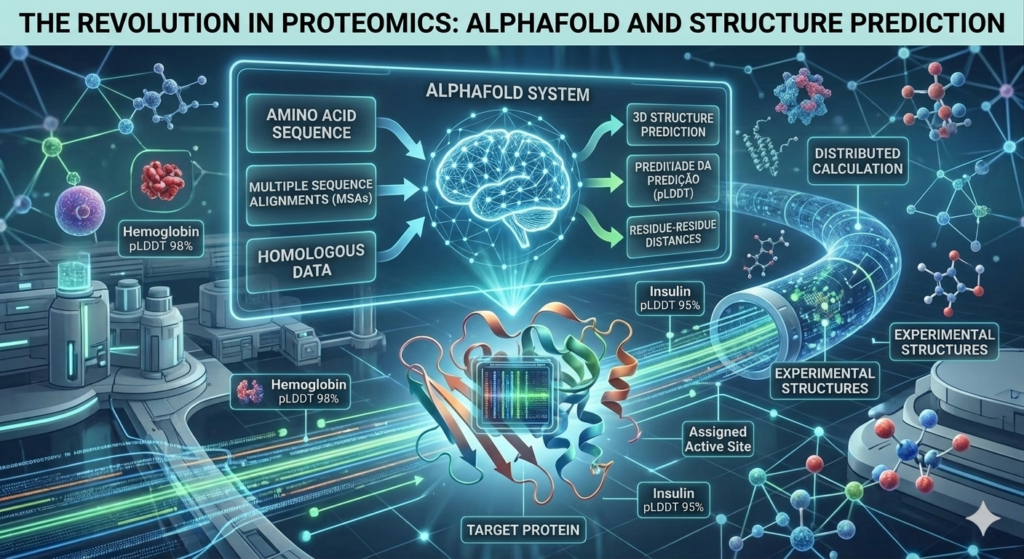
AlphaFold uses a deep neural network based on the Transformer architecture, optimized to interpret biological data. The process occurs in “refinement” cycles:
- Sequence Input: The user provides the amino acid sequence (the chemical “recipe”).
- Multiple Sequence Alignment (MSA): A bioinformatic technique that organizes three or more sequences to identify regions of similarity and structural/functional homology. It highlights mutations (insertions, deletions, substitutions) to infer relationships between proteins.
- Pair Representation: The AI analyzes the probable distance between each pair of amino acids, creating a contact map.
- Evoformer: This module processes evolutionary and geometric information simultaneously, exchanging data between the sequence and the 3D structure until it reaches a high-confidence consensus.
- Structure Module: Finally, it positions every atom in 3D space, generating a model that can be visualized and rotated.
📚 The Data “Diet”: What Fed the AI?
AlphaFold does not “guess”; it makes inferences based on real patterns extracted from decades of scientific experimentation. The database was fueled by three primary sources:
- PDB (Protein Data Bank): The central pillar. The PDB contains approximately 180,000 experimentally solved protein structures. AlphaFold used these examples to learn the “physical rules” of folding.
- UniProt: Provided billions of protein sequences, allowing the AI to understand genetic variation and evolution across different species.
- MGnify: A metagenomics database containing DNA sequences from varied environments (oceans, soil, digestive tracts). This expanded the AI’s vocabulary to proteins never before cultured in a lab.
🧬 The Scientific Impact
By cross-referencing this data, AlphaFold has been able to predict the structures of nearly all proteins known to science (approximately 200 million structures), creating a global catalog that is, today, the “Google Maps” of molecular biology. AlphaFold is the tool that bridges raw clinical data with a visual understanding of what happens inside a cell. It marks the beginning of the transition from descriptive biology to predictive biology.
Practical Impact: Why Does This Matter to You?
This breakthrough is not merely academic; it has direct, world-changing applications:
- New Medications: By understanding the protein structures of viruses and bacteria, scientists can design “keys” (medicines) that fit perfectly into them, accelerating the cure for diseases and helping to discover cures for others that do not yet have one.
- Fighting Pollution: AlphaFold is being used to engineer synthetic enzymes that “eat” plastic, helping to biologically clean our oceans.
- Food Security: Research allows for the development of crops more resistant to pests and climate change by predicting how plant proteins react to environmental stress.
Conclusion: AI As A New Lens for Science
AlphaFold has proven that advanced Artificial Intelligence is an extraordinary tool for deciphering the complexity of nature. It has not replaced biologists, biomedical researchers, and/or other science professionals, but has instead granted them an analytical “superpower” at an unprecedented speed.