
What is Generative Artifical Intelligence?
Generative AI is a branch of artificial intelligence focused on creating new content—such as text, images, audio, and code—based on patterns learned from massive datasets. It goes beyond simple analysis to achieve autonomous creative production.
Unlike traditional AI that merely classified data (like your email’s spam filter), Generative AI creates. Through Large Language Models (LLMs) and deep neural networks, it can generate high-fidelity text, images, programming code, and even videos from simple natural language instructions—the famous prompts.
If the telegraph allowed information to travel instantaneously, Generative AI is allowing that same information to transform, recreate, and multiply at an unprecedented scale.
In recent years, the tech world has undergone a paradigm shift. We moved from the era of “passive computing”—where computers only executed logical commands and organized data—to the era of Generative Computing. If you’ve felt that Artificial Intelligence has stopped being just a “pretentious spell-checker” to become a creative collaborator, you aren’t imagining things.
Understanding Generative AI
To understand Generative AI, we must first distinguish it from Traditional (or Predictive) AI. Traditional AI excels at classifying and predicting. It’s what decides if an email is spam or which movie you’d like on Netflix based on your history. It chooses an option from a bucket of existing choices.
Generative AI, on the other hand, creates something new. Trained on vast amounts of existing data, it learns the patterns, structure, and statistical probability of that information to generate an original result. When you request a text or an image, it isn’t performing a Google search and “cutting and pasting”; it is building every word or pixel from scratch, predicting what should come next.
How Machines Learned to Talk (The Technical Side)
The primary engine behind this revolution is the LLM (Large Language Model). But how does a machine, which only understands numbers (0 and 1), manage to write a poem or explain quantum physics?
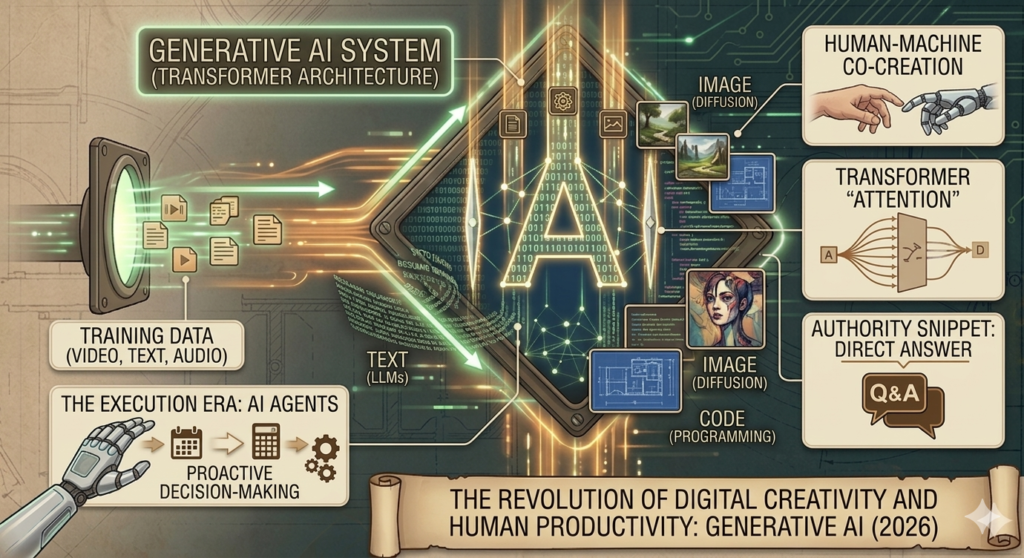
1. Transformers: The Turning Point Everything changed with a neural network architecture called the Transformer, introduced by Google in 2017. Before it, AIs read sentences word-for-word, in order, and often “forgot” the beginning of a sentence by the time they reached the end. Transformers introduced a mechanism called Attention. This allows the AI to analyze all parts of a sentence simultaneously, understanding context and the subtle relationships between words, regardless of the distance between them.
2. Tokens and Probability For the AI, words are converted into Tokens (chunks of words or numbers). Training involves exposing the model to billions of pages of text. The goal? To learn how to predict the next token. If I write “The sky is…”, the AI calculates that the probability of the next word being “blue” is much higher than “pineapple.” With billions of parameters, this “statistical prediction” becomes so sophisticated that it mimics human reasoning.
The Three Layers of Generative AI
For practical purposes, we can divide the use of generative AI into three major fronts:
- Text (Natural Language Processing): The ability to summarize long texts, change writing tones, translate languages with cultural nuances, and generate drafts for emails or articles.
- Image and Vision: Diffusion models that create images from descriptions. They start with visual “noise” (like a static TV screen) and refine that noise until the image you described is formed.
- Code and Logic: AIs that write and debug programming code. Even for non-programmers, this is useful for creating complex Excel formulas or automating simple computer tasks.
Productivity in Practice: How to Use It Today?
The question many ask is: “How does this help me if I’m not in IT?” The answer lies in reducing “blank page fatigue.”
- For Communication and Management Professionals: The biggest gain is in the distillation of information. You can provide a transcript of a one-hour meeting and ask: “List the 5 main points and the pending tasks for each participant.” What would take 40 minutes to review is done in 10 seconds.
- For Research and Study: AI acts as a 24/7 tutor. If you are studying a complex topic, you can ask: “Explain concept X as if I were 10 years old.” The ability to simplify and use analogies is one of the greatest technical virtues of current models.
- For Creatives and Designers: AI serves as an instant “mood board.” Before investing hours into a final project, you can generate 20 variations of a visual idea to test concepts, colors, and compositions.
- Generating Reports and Varied Texts: The application of AI in text drafting has become a central pillar of digital content creation, allowing bloggers and companies to generate drafts, refine tones of voice, and optimize metadata almost instantaneously. Through the use of deep neural networks and Transformer architectures, these tools do not merely suggest words; they understand the context to structure fluid paragraphs, create magnetic headlines, and ensure that the text is aligned with SEO best practices. This contextual reasoning capability allows content creators to move beyond being simple typists and become strategic editors, focusing on information quality while the artificial intelligence handles structure and productive agility.
The Challenge of “Hallucinations”
It’s not all sunshine and rainbows. Because AI operates based on statistical probabilities rather than a database of absolute facts, it can suffer from Hallucination. This happens when the AI generates information that looks true and is well-written but is factually false.
Therefore, the golden rule of AI productivity is: The AI is the brilliant intern, but you are the senior editor. Never publish or use sensitive data without human verification. The AI is a co-pilot, but you are the captain and you are in command.
The Future: From AI That Responds to AI That Acts
In 2026, we are witnessing the transition to AI Agents. While the current chat waits for you to ask, agents are designed to execute. Imagine saying: “Organize my schedule for next week, book the necessary meetings, and prepare a reading summary for each.” The agent will not only write the text but will access your calendar and send the invitations. We are moving from the “conversation” phase to the “execution” phase.
Conclusion
Generative AI is not a mystical entity but an incredibly advanced software tool that democratizes access to knowledge and creation. It does not replace human intelligence; it amplifies it, eliminating mechanical and repetitive tasks so we can focus on what truly matters: strategy, curation, and vision.
Generative AI is not the end of human creativity, but its greatest catalyst. Just as telegraph operators had to learn a new code to connect the world, we are learning the “language of machines” to expand the limits of what we can achieve. Regardless of your profession, mastering interaction with these machines—known as Prompt Engineering—will be one of the most valuable skills of this decade. The future does not belong to AIs, but to the humans who know how to use them.