
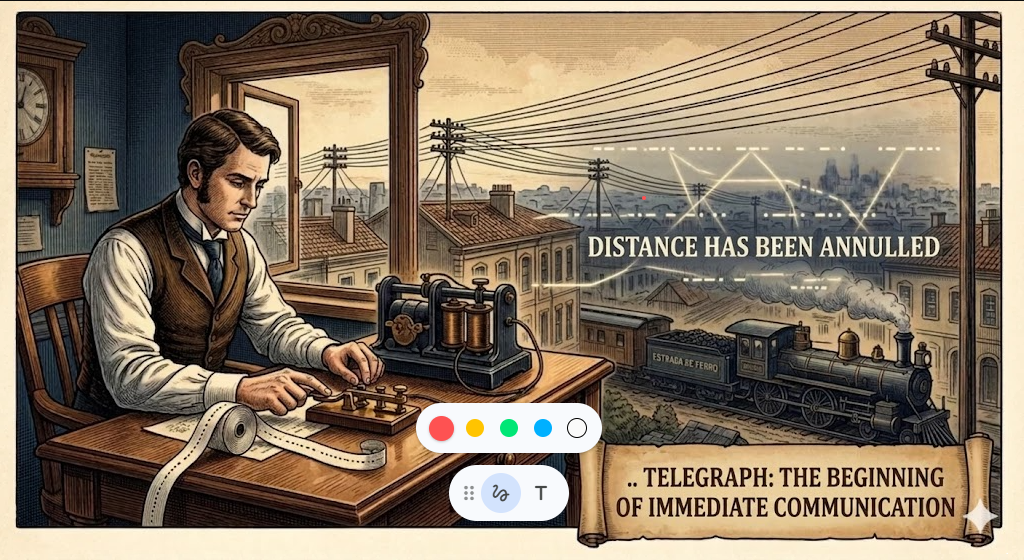
We live in an era where millisecond latency is a source of frustration. Artificial Intelligence processes billions of data points in fractions of a second, and information crosses oceans instantly through undersea fiber optics. However, to understand how we reached this level of connectivity, we must look back to a time when “high tech” consisted of copper coils, magnets, and a small metal key.
Before the rise of the electric telegraph, information faced an insurmountable physical limit: it could travel no faster than the medium carrying it. If news needed to travel from one city to another, it depended on horses, carrier pigeons, or the wind in a ship’s sails. The world was, by definition, disconnected and slow. The telegraph was not just a new machine; it marked the first time in human history that information detached from matter to travel at the speed of electricity.
The Genesis of an Idea: Pain as a Driver for Innovation
The history of the telegraph is punctuated by a tragic irony that serves as a reminder of why technology is, essentially, a tool for solving human problems. Samuel Morse, the name most associated with this revolution, was originally a painter. In 1825, while in Washington D.C. for a commission, he received a message from his father via horse messenger: “Your dear wife is recovering.” The next day, another message arrived: “Your wife has died.”
By the time Morse finally reached his home in New Haven, his wife had already been buried. The communication delay prevented him from saying goodbye. This personal trauma transformed into an obsession: to create a means of communication that was, by the standards of the time, instantaneous. Morse was not the only one—in England, William Cooke and Charles Wheatstone were also developing similar systems—but it was Morse’s system that, due to its simplicity and logic, would conquer the globe.
The Mechanics: The Elegance of Binary Simplicity
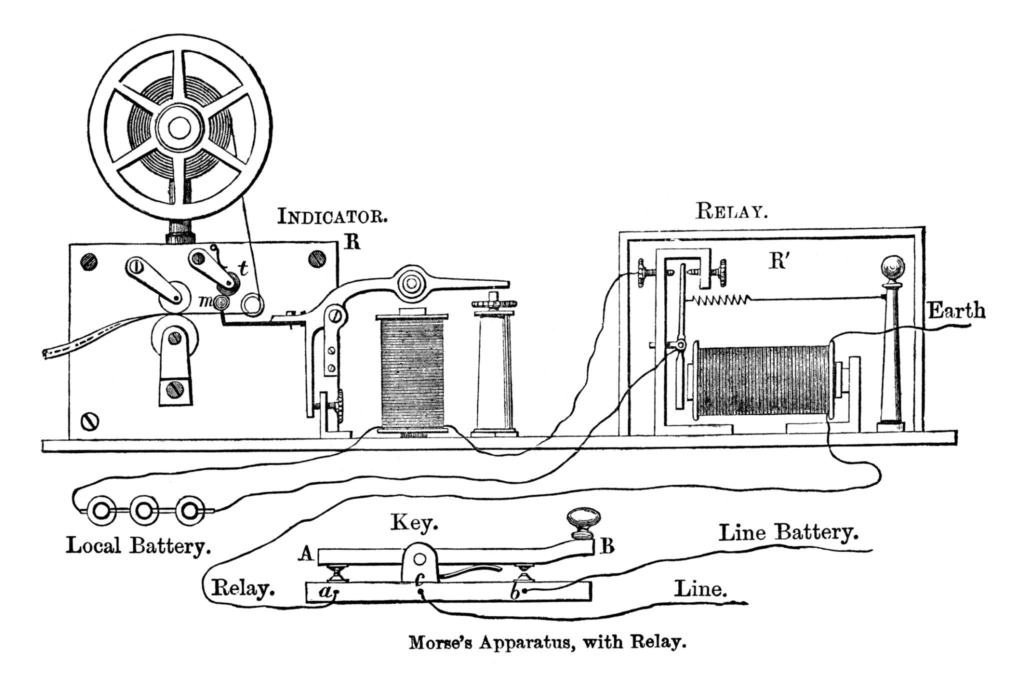
Link of this image: https://www.gettyimages.com.br/detail/foto/old-engraved-illustration-of-telegraph-morses-imagem-royalty-free/1224022160
To someone observing a telegraph key today, the simplicity seems archaic, yet the logic behind it is the same as that of modern computers. The system is based on a simple electrical circuit. Imagine a wire connecting two cities. At Point A (the Sender), there is a battery and a key (the manipulator). At Point B (the Receiver), there is an electromagnet and a stylus that can mark paper or emit a sound.
When the operator at Point A presses the key, the circuit closes. Electricity travels through the wire and activates the electromagnet at Point B, which pulls a lever. Upon releasing the key, the circuit opens, and the electromagnet releases the lever.
Morse’s genius was not just the hardware, but the “software”: Morse Code. Since the system could only transmit two states—”current on” or “current off”—he created a binary system of dots (short presses) and dashes (long presses). The entire alphabet was mapped to these combinations. The letter “E,” the most common in the English language, was assigned a single dot (•) to save time. The letter “Q” was more complex (–•-).
This was the first time human language was encoded for machine transmission. Without Morse Code, we might not have the binary code (0 and 1) that powers all our devices today.
The “Victorian Internet” and the Paradigm Shift
When the first telegraph lines were installed, many were skeptical. Some called it “witchcraft” or claimed wires could not carry words. But practical utility soon silenced the critics. The telegraph found its first great partner in the Railroads. Before its invention, trains operated on rigid schedules, and the risk of head-on collisions was enormous if a train ran late. With the telegraph, station masters could coordinate traffic in real-time.
Soon, the impact expanded to every pillar of society:
- The Birth of Modern Journalism: Before the telegraph, news was “old” for weeks. Its arrival gave birth to news agencies like the Associated Press and Reuters. The concept of the “breaking news scoop” was born here. If something happened in New York, London knew within minutes.
- The Globalization of Financial Markets: The price of coffee, gold, or stocks became uniform across different regions. Markets shifted from local to global, creating the infrastructure for modern capitalism.
- Governance and Warfare: Governments could control distant provinces with an iron fist, and generals could command battles from across the continent. The American Civil War was the first major conflict “managed” via telegraph.
Technology and Productivity: The First “Information Workers”
As an enthusiast of technology-assisted productivity, it is fascinating to observe that the telegraph created the first class of professionals whose job was purely to handle data: the telegraph operators.
They developed impressive multitasking skills, becoming capable of “reading” the code (deciphering clicks by sound) while simultaneously writing the message. However, the telegraph also brought about the first modern occupational health issues. Operators suffered from “Glass Arm,” a form of Repetitive Strain Injury (RSI) caused by the repetitive motion of tapping the key for hours on end.
Furthermore, the “pressure for urgency” was born with the telegraph. Where once you might wait a month for a letter, a response was now expected in minutes. The stress of constant connectivity, which we attribute to smartphones today, actually began with the metallic “tick-tick” of telegraph stations.
The Legacy: The Wire That Never Broke
Although the telegraph was eventually replaced by the telephone, the telex, and finally the internet, its legacy is immortal. It proved that information is the world’s most valuable asset and that technology has the power to shrink the planet.
When we look at Artificial Intelligence and Agentic AI today, we are seeing the latest chapter of a process started by Samuel Morse. Where he used dots and dashes to send a message of solace, we use neural networks to predict behavior and automate life. Yet the foundation remains the same: electrical pulses carrying human thought through space.
The telegraph taught us that technology is not just about fast machines, but about our intrinsic need to be present, even when we are far away. It was the first great step toward the global village we live in today.
Further Reading: