
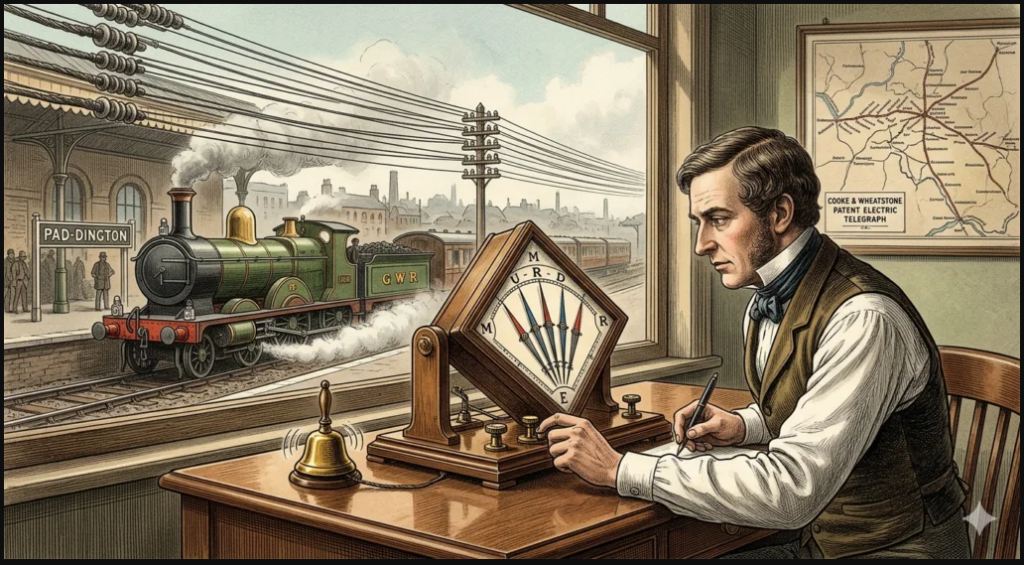
While Samuel Morse was developing his solution in the United States, a technically more complex but equally revolutionary system was being born across the Atlantic in England: the Cooke and Wheatstone Telegraph.
Unlike Morse’s system, which relied on an abstract code (dots and dashes), the British model focused on direct visual reading, becoming the first electric telegraphy system to be commercially exploited in the world.
Cooke & Wheatstone: The Engineering Behind the World’s First Commercial Telegraph
If Samuel Morse gave the world a “language” for machines, British innovators William Fothergill Cooke and Charles Wheatstone gave the world its first functional commercial network. Before Morse’s dots and dashes dominated the oceans, the United Kingdom was already pulsing electricity through magnetic needles that looked like something out of a Jules Verne novel.
In this article, we dive into the history of the system that inaugurated the era of instant connectivity and understand why, despite its visual brilliance, it eventually gave way to the American model.
An Unlikely Partnership: The Entrepreneur and the Scientist
The story of this telegraph begins in 1836. William Cooke, a former army officer with an eye for business, was fascinated by the idea of using electricity to send messages. However, he lacked deep technical knowledge. He teamed up with Charles Wheatstone, a brilliant scientist and professor of experimental physics who was already conducting advanced experiments with electrical circuits.
On June 12, 1837, they patented the first practical electric telegraphy system. While Morse was still struggling to secure funding in the U.S., Cooke and Wheatstone were already installing their first experimental line along the railway tracks between Euston and Camden Town in London.
How It Worked: The Fascination of Magnetic Needles
The defining feature of the British system was its intuitiveness. While Morse required the operator to learn a new alphabet, the Cooke and Wheatstone system was visual and direct.

Link of the image:
https://blog.sciencemuseum.org.uk/wp-content/uploads/sites/12/2014/10/Five-needle-telegraph-Information-Age-c.ScienceMuseum-SSPL1-683×1024.jpg
Link of the image: https://blog.sciencemuseum.org.uk/wp-content/uploads/sites/12/2014/10/SSPL_10213638_HighRes-21.jpg
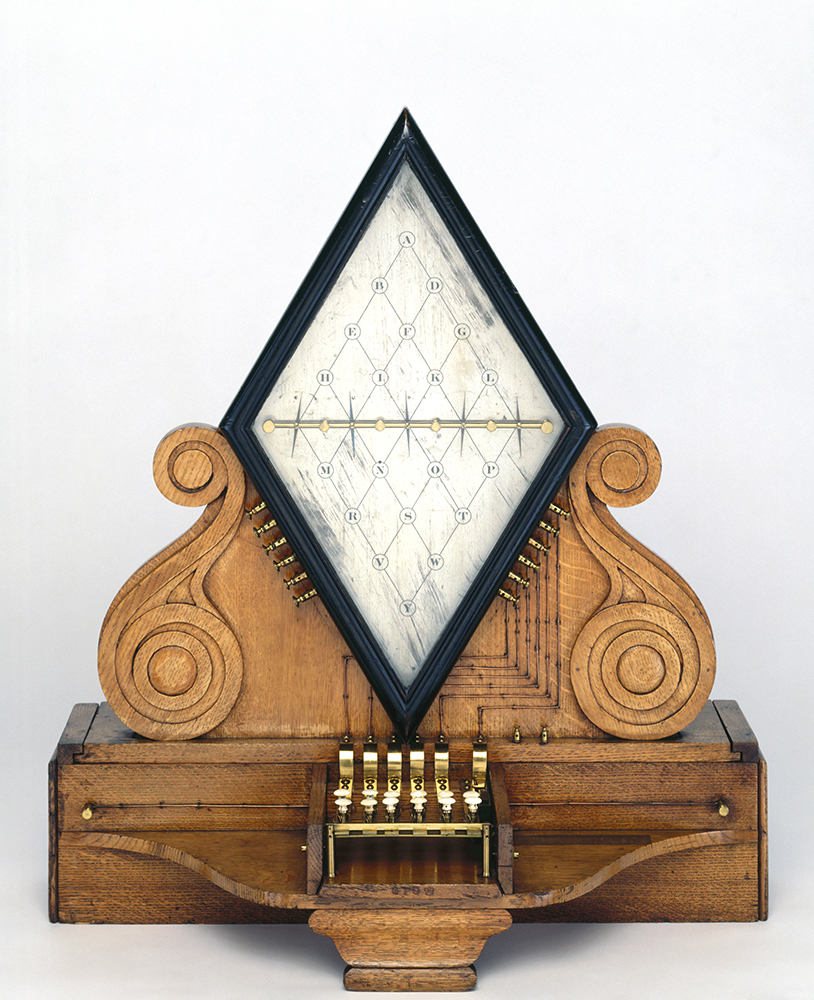
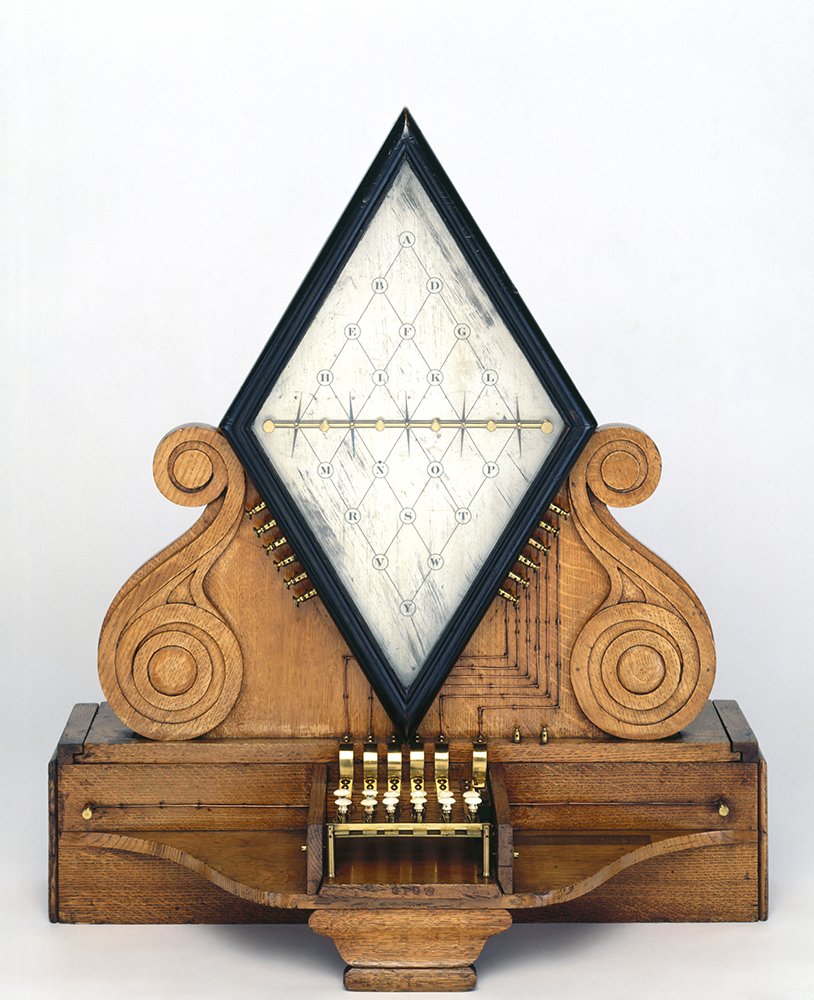
- The Diamond Panel: The device consisted of a vertical diamond-shaped panel where five magnetic needles were suspended on axes. The letters of the alphabet were painted directly onto the panel.
- The Geometry of Information: To transmit a letter, the operator engaged two keys simultaneously. This sent an electric current through two specific wires, creating a magnetic field that deflected two needles on the receiver. The needles tilted toward each other, and the point where the axes of the two needles visually “crossed” indicated the intended letter.
It was an almost “magical” system for the time: you didn’t need to decipher codes; you simply read where the needles pointed.
The Peak and the Case That Shocked London
The system became an immediate success on British railways, but its definitive public validation occurred in 1845, in an episode worthy of a movie script.
A man named John Tawell committed a murder in Slough and fled on a train to London. The police used the Cooke and Wheatstone telegraph installed at the station to send the criminal’s description to Paddington Station. When Tawell stepped off the train, officers were already waiting for him. It was the first time technology “ran” faster than crime, proving that the telegraph was an incalculable tool of civil power.
The Transition: How Long Did It Last?
If it was so intuitive and worked so well, why don’t we use it today? The Cooke and Wheatstone needle system reached its peak between 1837 and 1850. During this period, it was the backbone of British railways. However, Morse’s single-wire system began to be introduced in Europe around 1848 and quickly proved to be economically superior.
The Coexistence and Final Replacement:
- 1850 – 1860: A decade of coexistence. The British system evolved from five needles to two, and eventually to just one (to reduce wiring costs). However, this made it nearly as difficult to learn as Morse code, stripping away its primary advantage: ease of use.
- 1870: With the nationalization of telegraphs in the UK and the creation of the General Post Office (GPO), a standardization effort began. The needle system was relegated to short-distance internal railway branches.
- Late 19th Century: By the 1890s, the Morse telegraph was the absolute standard for long-distance and transatlantic communications.
The Cooke and Wheatstone system survived in “niche” manual railway signaling until the early 20th century, but as a global communication network, it was completely eclipsed by the simplicity and low cost of the Morse model between 1870 and 1880.
The Legacy of the British System
Although it lost the “standards war,” Cooke and Wheatstone left a fundamental legacy. They proved that the telecommunications market was viable and profitable. Their approach, focused on user experience (ease of reading), echoes today in the development of graphical user interfaces (GUIs).
Final Reflection
The Cooke and Wheatstone telegraph can be viewed as the “High Engineering” of its time (complex and intuitive), while the Morse system was the “Software Innovation” (simple hardware, intelligent encoding).
In the world of technology, the system that wins is often not the most visually “elegant,” but the most efficient and cheapest to scale—a lesson that resonates today in the competition between different programming languages and system architectures. Cooke and Wheatstone built the first Ferrari of communications; Samuel Morse built the first “Beetle”: simple, affordable, and capable of conquering the world.
However, a very honorable mention must go to the Cooke & Wheatstone system: beyond its technological merit, it helped capture a murderer in 1845 (The Case of John Tawell), marking one of the first—if not the very first—recorded cases of a criminal arrested and convicted with the aid of technology.
Further Reading