
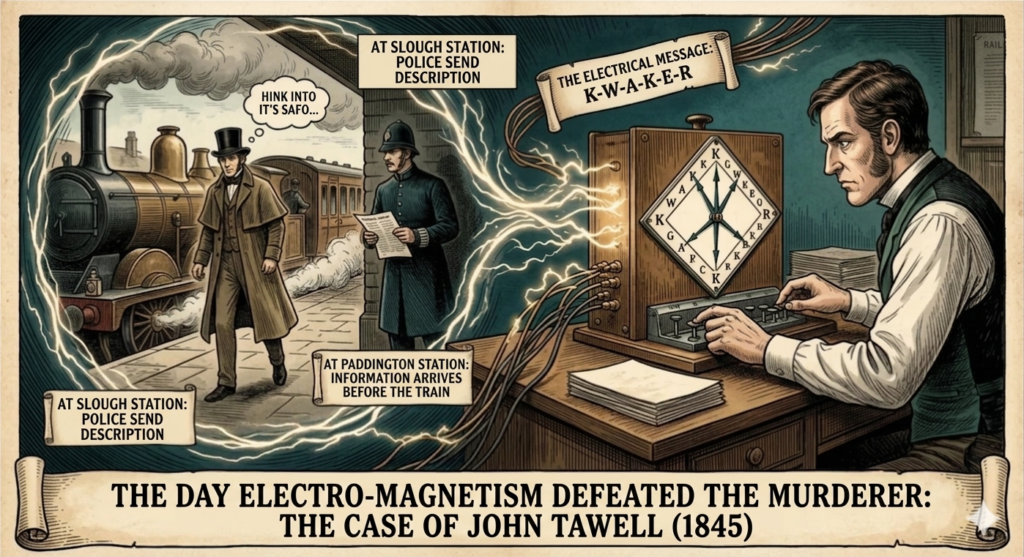
In the 19th century, crime held a physical advantage: speed. If a criminal could hop on a horse or board a train, they were, for all intents and purposes, gone. Information simply could not travel faster than man. But that all changed on a January night in London in 1845, thanks to a machine of magnetic needles and a copper wire.
This is the true story of John Tawell—the man “caught by a wire.”
The Village Crime
John Tawell was a man with a dark past. He grew up in London working in various retail shops, but at one point in his life, he was arrested for bank forgery. At the time, such a crime was punishable by death. Tawell was sentenced to execution; however, thanks to the intervention of his former employers, his sentence was commuted to 14 years of transportation to the then-British penal colony of Sydney, Australia. He served only a few years in custody, as he was granted a ticket-of-leave for what we would today call good behavior. Once free, Tawell opened the colony’s first pharmacy and, through it, prospered financially. He married and had children there.
After returning from exile in Australia, he led a life of respectable appearance in London. However, Tawell began a secret relationship with Sarah Hart, who became his mistress and with whom he had two children in Slough—a town about 20 miles west of London. A few years into the affair, seeking to rid himself of the costs of this secret, Tawell decided to murder Sarah with cyanide. He secretly poisoned his mistress while she innocently drank beer with him.
After committing the crime, Tawell walked to Slough station and boarded the 7:42 PM train bound for Paddington Station in London. He believed that once in the metropolis, he would be invisible. What John Tawell didn’t know was that the Cooke and Wheatstone telegraph had just been installed on that railway line.
“The Electric Messenger”
Neighbors heard Sarah’s moans—she did not die instantly—and the police were quickly summoned. Upon discovering that a suspicious man in a long, dark coat had boarded the train, officers rushed to the station’s telegraph.
They sent the following message to Paddington:
“A MURDER HAS JUST BEEN COMMITTED AT SALT HILL AND THE SUSPECTED MURDERER WAS SEEN TO TAKE A FIRST CLASS TICKET TO LONDON BY THE TRAIN THAT LEFT SLOUGH AT 7.42PM. HE IS IN THE GARB OF A KWAKER WITH A BROWN GREAT COAT ON WHICH REACHES HIS FEET. HE IS IN THE LAST COMPARTMENT OF THE SECOND FIRST-CLASS CARRIAGE”
There was a curious technical detail: the Cooke and Wheatstone five-needle telegraph did not have the letter “Q.” The operator, thinking quickly, had to spell “Quaker” as “K-W-A-K-E-R.”
The message raced through the wires at the speed of light, far outstripping the steam locomotive. When Tawell disembarked in London, he was followed discreetly by an undercover railway policeman who was already waiting for him. The officer tailed Tawell until the following morning, when he was arrested at a coffee house by agents of the Metropolitan Police Force. (Note: English railway police at the time had no power outside train stations, so the railway officer followed Tawell only to confirm his identity and location before calling in the department with jurisdiction over London’s streets.)
Legal and Social Impact
Tawell’s trial was a sensation. The defense tried to argue that Sarah had died from eating too many apple seeds (which contain traces of cyanide), but forensic science and the testimony regarding the speed of communication condemned him. Tawell was hanged in a public square on March 28, 1845.
For the public of the time, the telegraph ceased to be a scientific curiosity and began to be seen as a force for order. The Times wrote that the telegraph was “the long arm of justice.” The case’s impact and the recognition of the telegraph’s role were so significant that the device at Paddington Station that received the message was eventually added to the collection of the Science Museum in London.
Lessons in Productivity and Technology for Today
As technology and productivity professionals, the Tawell case teaches us something fundamental: connectivity changes the rules of the game.
- Latency Reduction: Crime lost to the low latency of electrical communication.
- The Era of Monitoring: This marked the birth of the modern concept that no matter how far you go, your data (or your description) can arrive before you do.
- Law and Innovation: This was one of the first cases where technological evidence (communication via electrical pulses) was accepted as a fundamental basis for a criminal investigation.
John Tawell was the first criminal in history to be “caught by a wire” and remains one of the first known cases—if not the very first—of a delinquent captured with the aid of technology. Today, in a world of digital surveillance and AI tracking, we are living through the ultimate evolution of the same concept born on the tracks of the Great Western Railway.
Did you know this story? What are your thoughts? Comment at the bottom of the page… Plus, you may also like the article below: