
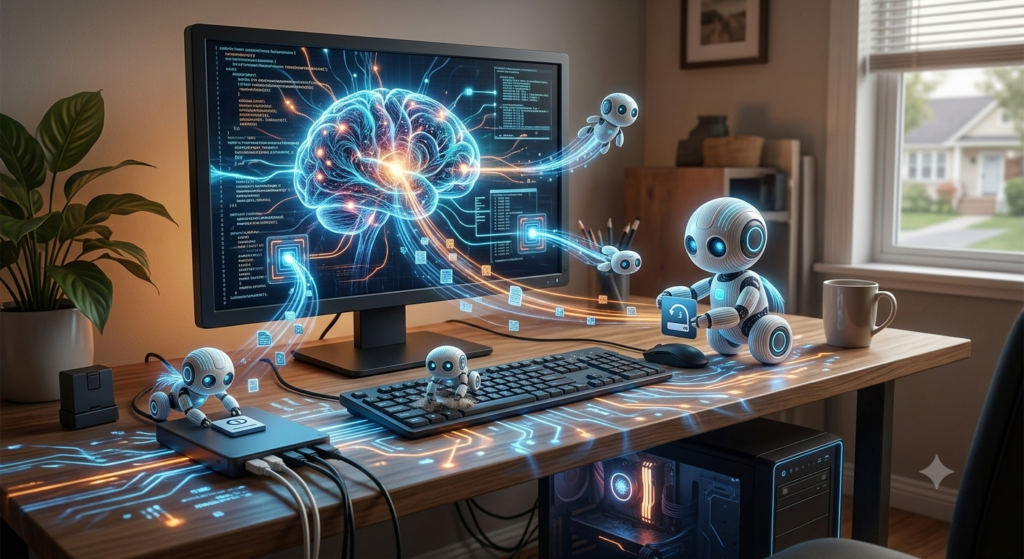
Imagine having an assistant that doesn’t just answer your questions, but actually opens your files, organizes your folders, drafts reports, conducts web research, and executes complex tasks—all autonomously, while you focus on what really matters. That is Claude Cowork.
Launched on January 12, 2026, by Anthropic, Cowork represents one of the most significant shifts in the concept of AI assistants: the transition from a chatbot that answers to an agent that executes.
What is Claude Cowork?
Claude Cowork is an agentic AI tool designed by Anthropic to automate complex, multi-step tasks for non-technical users. Unlike conventional chat interfaces, Cowork can autonomously plan and execute workflows directly on your computer.
While traditional chatbots require users to manually upload files, Cowork can read, edit, and create documents directly on your machine, operating on explicit, permission-based access.
Simply put: you describe what you want in plain English—no technical expertise required—and Cowork maps out the necessary steps and executes them one by one, keeping you updated throughout the process.
How Cowork Came to Be
Claude Cowork was built on the same technical foundations as Claude Code—Anthropic’s agentic coding tool tailored for developers. Anthropic noticed a compelling trend: developers were using Claude Code for far more than just programming. Users began delegating administrative tasks, file organization, and research to the terminal agent.
By launching Cowork, Anthropic captured this broader market of knowledge workers who require a high level of automation but lack the technical expertise to operate command-line interfaces.
Fun Fact: The Anthropic team actually built Cowork using Claude Code—and they pulled it off in just two weeks.
How It Works: Cowork vs. Standard Chat
This is the most critical distinction to understand about the product:
- Standard Claude Chat: The AI responds to your prompts but cannot interact with your local environment or access files directly.
- Claude Cowork: Claude has permission to read, edit, and create files within folders you specify. This allows it to actually complete tasks instead of just telling you how to do them.
Cowork runs natively on the desktop, where the vast majority of knowledge work happens: within local files, directories, and everyday applications. It moves between tasks, synthesizes information from multiple sources, and closes out workflows without requiring the user to micro-manage every single step.
The workflow is straightforward:
- Select a folder and grant access permissions to Cowork.
- Describe the task using natural language.
- Cowork analyzes the request, maps out an action plan, and presents it for your approval before execution.
- Track progress in real time—or simply step away and check back when it’s done.
- For recurring tasks, set the schedule once, and Cowork handles the rest.
Where Cowork Lives: Inside the Claude Desktop App
Cowork is integrated directly into the Claude Desktop application as a third operational mode—sitting right alongside Chat and Code. Simply toggle over to Cowork mode when you want Claude to execute tasks that don’t involve software development.
The Claude Desktop app, which initially launched exclusively for macOS, rolled out to Windows on February 10, 2026, instantly bringing Cowork to roughly 63% 1 of desktop users worldwide.
Core Features
📁 File Management & Organization Local file systems pile up clutter faster than anyone can keep track of. Point Cowork toward a messy folder full of drafts, downloads, and attachments and ask it to rename, sort, deduplicate, or highlight what’s relevant.
📄 Document & Report Generation The hardest part of writing a report is rarely the actual writing; it’s the data aggregation. Hand over a collection of source files, and Cowork will assemble a structured draft, taking care of the parsing and synthesis so you only have to focus on polishing the final product.
🔄 Scheduled & Recurring Workflows With scheduled tasks, you can instruct Claude to check your inbox every morning, pull metrics from analytics dashboards, or compile your weekly Slack digest. You configure the cadence once; Claude runs the routine.
🖥️ Computer Use In March 2026, Anthropic integrated its “Computer Use” capability directly into Cowork. This allows Claude to visually read your screen, move the cursor, and input keystrokes just like a human operator. Consequently, Cowork can open local applications, manage browser tabs, and interact with specialized software suites that lack API integrations.
📱 Dispatch — Mobile Control Dispatch serves as a mobile-to-desktop bridge, allowing users to queue up and assign tasks from their smartphone for execution back on their computer. It supports advanced scheduling and integrates natively with services like Slack and GitHub.
🔌 Connectors and Ecosystem Integrations The app marketplace already boasts hundreds of enterprise-ready integrations: AWS Marketplace for cloud resources, n8n for workflow automation, Honeycomb for observability data, and Fellow.ai for meeting insights. Every connector undergoes vetting by Anthropic, and custom enterprise connectors can be deployed. Furthermore, built-in Chrome integration allows Cowork to browse web pages and run online queries as part of larger multi-step tasks.
🧩 Specialized Domain Plugins In January 2026, Anthropic released 11 open-source plugins for Cowork spanning core business domains: Sales (CRM sync and commercial proposal generation), Legal (document drafting and contract analysis), and Finance (reconciliation, ledger entries, and variance analysis).
Security and Control: The AI That Asks for Permission
A fundamental differentiator for Cowork is its stringent approach to security:
Cowork was engineered with human-in-the-loop oversight at its core. It executes tasks, but high-consequence decisions remain entirely with the user.
The system enforces a strict permission protocol: Claude must request explicit authorization before opening new applications, and users can monitor the AI’s step-by-step progress via the mobile app. The system also includes hard rails that block access to sensitive financial or administrative system settings without multi-factor authentication (MFA) from the device owner.
You choose exactly which directories and connectors Claude can touch. Before making a move, it outlines its plan and waits for your green light. You can redirect, refine, or abort the operation at any moment. Files are processed locally, and Anthropic does not use customer data to train its models.
Does Cowork Replace Claude Chat?
No, the two features operate together within the same Claude Desktop ecosystem, serving distinct purposes:
| Mode | Core Purpose |
|---|---|
| Chat | Conversations, Q&A, open-ended analysis, brainstorming, and text generation. |
| Code | Agentic, terminal-based software development for programmers. |
| Cowork | Autonomous task execution across local files, folders, and desktop apps. |
You can start a strategy session inside Chat, flesh out an outline, and then hand it over to Cowork to execute the legwork—they are complementary tools, not competitors.
Pricing and Availability
Claude Cowork is included across all paid tiers within the Claude Desktop application. There is no additional premium or separate subscription required to unlock Cowork functionality. Note that pricing plans vary by region and tier, and as of this writing, Cowork remains exclusive to paid tiers and is unavailable on the free plan until the date of publication of this post.
Who Is Claude Cowork Built For?
Cowork targets anyone whose daily workflow involves time-consuming, repetitive computer tasks that don’t require software engineering skills. Researchers, business analysts, operations managers, legal professionals, and accounting teams—anyone who handles data, documents, and files daily—can leverage Cowork to offload formatting and compilation, saving their energy for high-level editorial judgment.
What Cowork Means for the Future of AI
The rollout of Claude Cowork signals a definitive industry pivot: the evolution from “copy-and-paste AI” to “executable AI.” By bringing agentic automation directly to the desktop, Anthropic is forcing competitors like Microsoft and Google to look beyond sidebar assistants and move toward deeper, native operating system integration.
With Cowork, your computer isn’t just a tool anymore—it’s a workstation that keeps running even when you step away.
Leave a comment down below… Oh, and you might also like the following article:
- Updated percentage as of the publication date of this article, according to the Stat Counter Global Stats website:
https://gs.statcounter.com/os-market-share/desktop/worldwide ↩︎