
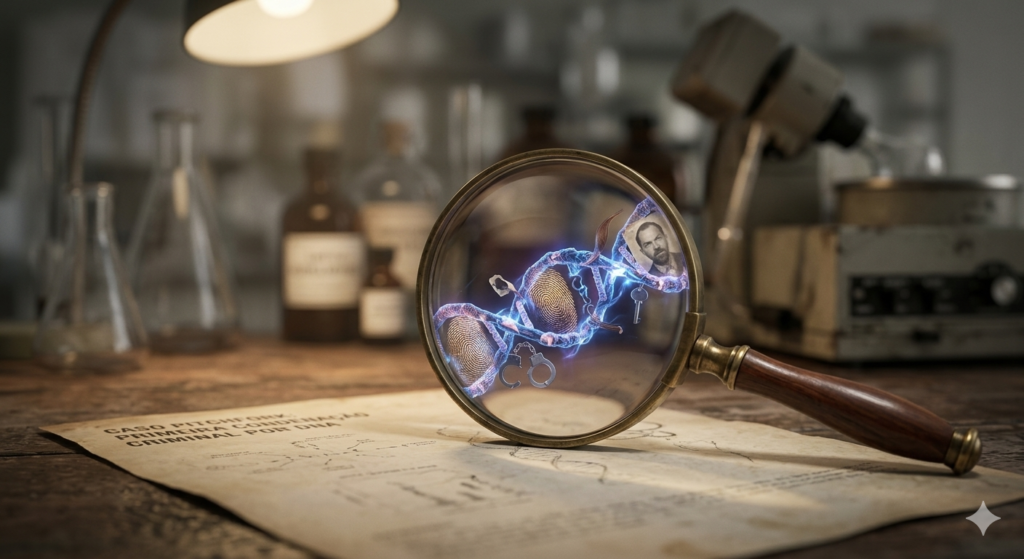
The Colin Pitchfork Case: A Landmark in Forensic History
The Colin Pitchfork case stands as one of the most critical milestones in global forensic history. It marked the first time that DNA profiling (then known as DNA fingerprinting) was used to solve a crime and secure a conviction. Furthermore, it was the first time this technology was used to exonerate an unjustly accused suspect.
1. The Crimes
The crimes took place in the village of Narborough, Leicestershire, England, during the 1980s.
- Lynda Mann (1983): In November 1983, 15-year-old Lynda disappeared while walking home from a friend’s house. Her body was found the following morning; she had been raped and strangled. At the time, police collected semen samples from the attacker, but analysis was limited to blood typing, which could not identify a specific individual.
- Dawn Ashworth (1986): In July 1986, another 15-year-old, Dawn Ashworth, was killed in a nearly identical manner on a nearby footpath. The brutality and similarities between the cases led police to believe a serial killer was operating in the region.
2. The Investigation and the DNA Breakthrough
Police initially arrested a 17-year-old named Richard Buckland, who worked at a local hospital. Under the pressure of interrogation, Buckland confessed to the murder of Dawn Ashworth but denied killing Lynda Mann.
At the same time, scientist Alec Jeffreys at the University of Leicester had just discovered that every person’s DNA possesses unique patterns. The police decided to put this new technique to the test:
- Exoneration: By comparing the semen found on both victims’ bodies with Buckland’s blood, Jeffreys proved that the attacker’s DNA was the same in both cases, but it did not belong to Buckland. The confession had been false. Buckland became the first person in history to have his innocence proven by DNA.
- Mass Screening: Lacking a suspect, the police took an unprecedented step: they requested blood and saliva samples from approximately 5,000 young men in the surrounding villages.
3. The Capture of Colin Pitchfork
Colin Pitchfork, a 27-year-old local baker, attempted to bypass the system. He convinced a coworker, Ian Kelly, to provide a sample in his place, claiming he already had a police record for indecent exposure and feared being unfairly targeted.
The ruse lasted nearly a year until a conversation in a pub changed everything. A woman overheard Kelly describing how he had fooled the police to help Pitchfork. She reported the incident, and in September 1987, Pitchfork was arrested.
4. The Final Test and Conviction
This time, police collected Pitchfork’s actual blood. The DNA test was indisputable: the genetic patterns in his cells perfectly matched the fluids found on Lynda Mann and Dawn Ashworth.
Faced with overwhelming scientific evidence, Colin Pitchfork confessed to the crimes. In 1988, he was sentenced to life in prison. The case not only ended the terror in Leicestershire but forever transformed criminal investigation, establishing DNA as the “Queen of Evidence” in modern justice.
The Technical Side: How Machines “Talked” in 1986
In the Pitchfork case, the genetic comparison wasn’t performed by a computer or automated equipment like today’s systems. Instead, it was a manual, chemical laboratory process called DNA Fingerprinting. Since the technology was in its infancy, the “equipment” was actually a series of benchtop procedures that resulted in a physical image for visual analysis.
The Method: RFLP
The comparison utilized a technique called Restriction Fragment Length Polymorphism (RFLP). The final “result” did not appear on a screen but on an X-ray film called an autoradiograph.
The Step-by-Step Process:
- Enzymatic Digestion: DNA extracted from the crime scene samples and the blood samples (from Pitchfork and other volunteers) was “cut” by restriction enzymes.
- Gel Electrophoresis: The DNA fragments were placed on a gel plate and subjected to an electric current. This separated the pieces by size, creating an invisible trail.
- Southern Blot: The DNA was transferred from the gel to a sturdy nylon membrane for easier handling.
- Radioactive Probes: Radioactive DNA probes were applied, which bound to specific sequences (minisatellites).
- X-ray Development: The membrane was placed against X-ray film. Where the radioactive probes had attached, dark bands appeared, creating a pattern similar to a barcode.
The Final Comparison
Forensic experts performed the comparison manually by placing the X-ray film of the suspect’s sample side-by-side with the film from the crime scene sample.
In the case of Colin Pitchfork, Sir Alec Jeffreys’ team observed that the bar pattern from Pitchfork’s blood was an identical match to the pattern found in the semen recovered from the crime scenes. This led to his confession and ultimate conviction.
Did you know about this case? What are your thoughts on this forensic revolution? Let us know in the comments!