
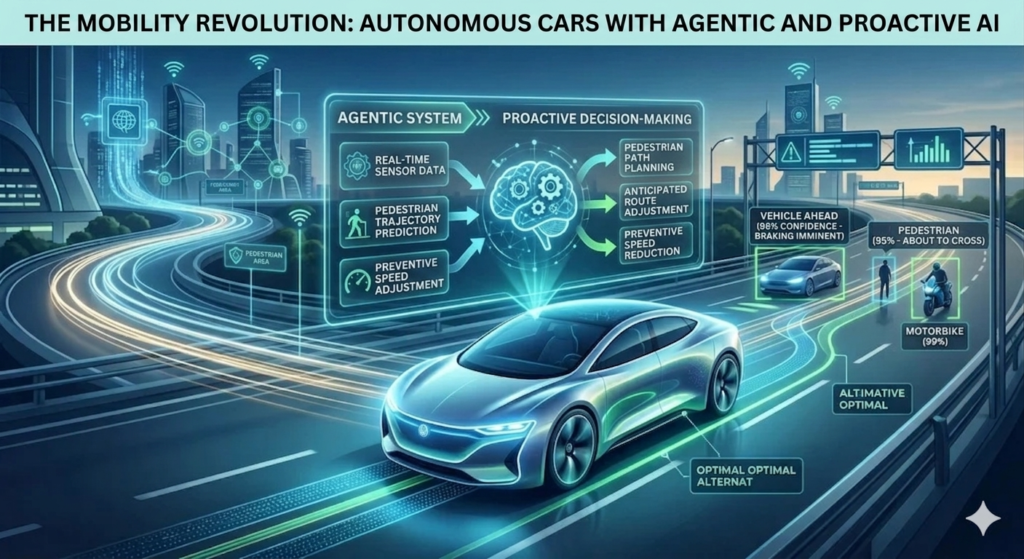
Autonomous vehicles are perhaps the most visible and complex practical examples of Agentic and Proactive AI that we have today. To understand why they earn these labels, we must analyze what these terms mean within the context of software engineering and artificial intelligence.
1. Why is it “Agentic” AI?
An AI is considered an agent when it has the capacity to perceive its environment, reason about it, and act independently to achieve a specific goal (in this case, getting you from Point A to Point B safely).
- Decision Autonomy: Unlike “passive” AI (such as a text translator that only acts upon your request), an autonomous car operates in a continuous decision cycle. It doesn’t wait for commands for every turn; it takes responsibility for executing the task from start to finish.
- Interaction with the Environment: It is an “embodied AI” system. Its decisions have immediate physical consequences in the real world, requiring a level of agency far superior to that of a chatbot.
2. Why is it “Proactive” AI?
Proactivity is a system’s ability to anticipate needs and problems before they occur, rather than merely reacting to stimuli.
- Intent Prediction: Autonomous vehicles don’t just see a pedestrian on the sidewalk (reactive); they use probabilistic models to predict whether that pedestrian intends to cross the street (proactive).
- Defensive Driving: If the system detects a car in the next lane driving erratically, it may proactively decide to increase the safety distance or change lanes before there is even an imminent risk of collision.
- Route Optimization: The system can proactively suggest or alter the path upon detecting congestion ahead, aiming for mission efficiency without the passenger needing to request it.
The Practical Difference
| AI Type | Behavior in Traffic |
| Reactive | Slams on the brakes when it detects a stationary obstacle directly ahead. |
| Proactive (Agentic) | Smoothly decelerates upon realizing, yards in advance, that traffic is starting to thicken or that a traffic light is about to turn red. |
Summary
Agentic and proactive AI transforms autonomous vehicles from simple reactive machines into systems endowed with real autonomy and predictive safety. While agency allows the car to make independent decisions and manage complete missions without constant supervision, proactivity ensures the system anticipates risks and the intentions of others before a danger even materializes.
This evolution is what enables the transition from driver assistance to Full Self-Driving (Level 5), making traffic not just automated, but intelligent, fluid, and capable of saving lives through an ethical and strategic perception of the world.
Ultimately, the transition from reactive AI to agentic and proactive systems represents the true “game-changer” for urban mobility. By ceasing to be a mere passenger of circumstances and becoming an agent capable of predicting intentions and acting strategically, the autonomous vehicle evolves from a technological promise into a public safety solution. We are facing a new era where the act of driving is replaced by the intelligence of navigating, transforming our streets into ecosystems that are more fluid, ethical, and, above all, human.
💬 What are your thoughts on this? 🤔
Would you trust your safety to a proactive AI agent today, or do you still prefer to keep your hands on the wheel? Let us know in the comments!